
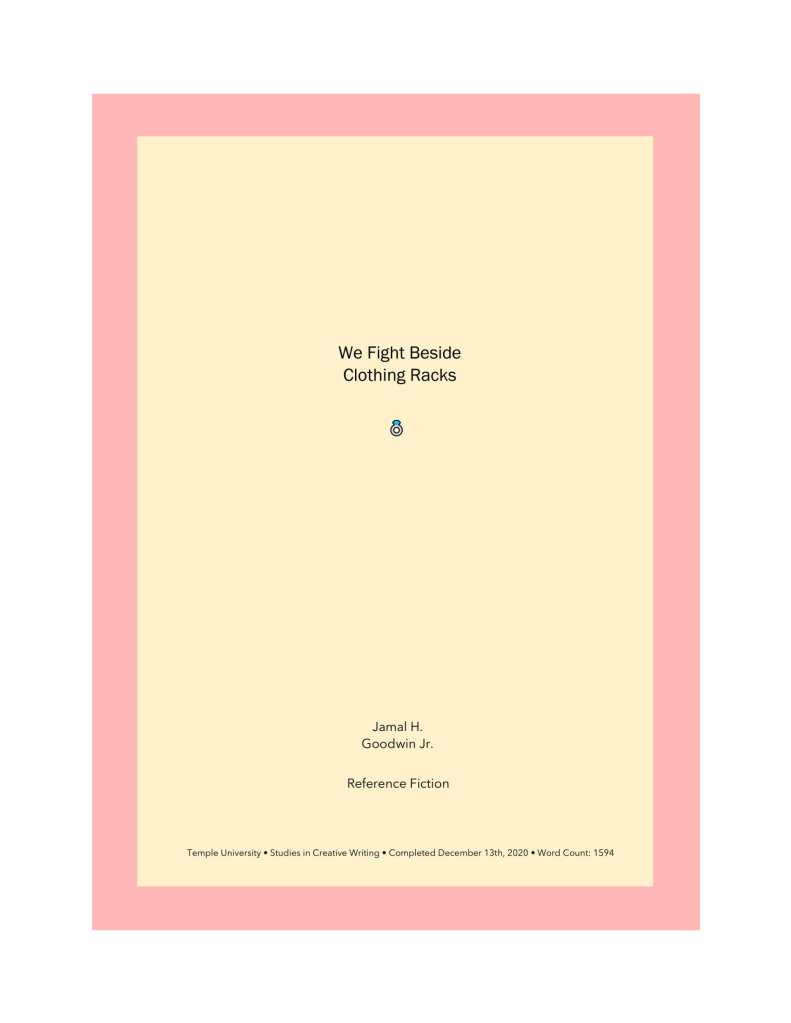
We Fight Beside Clothing Racks

Origin of This Piece:

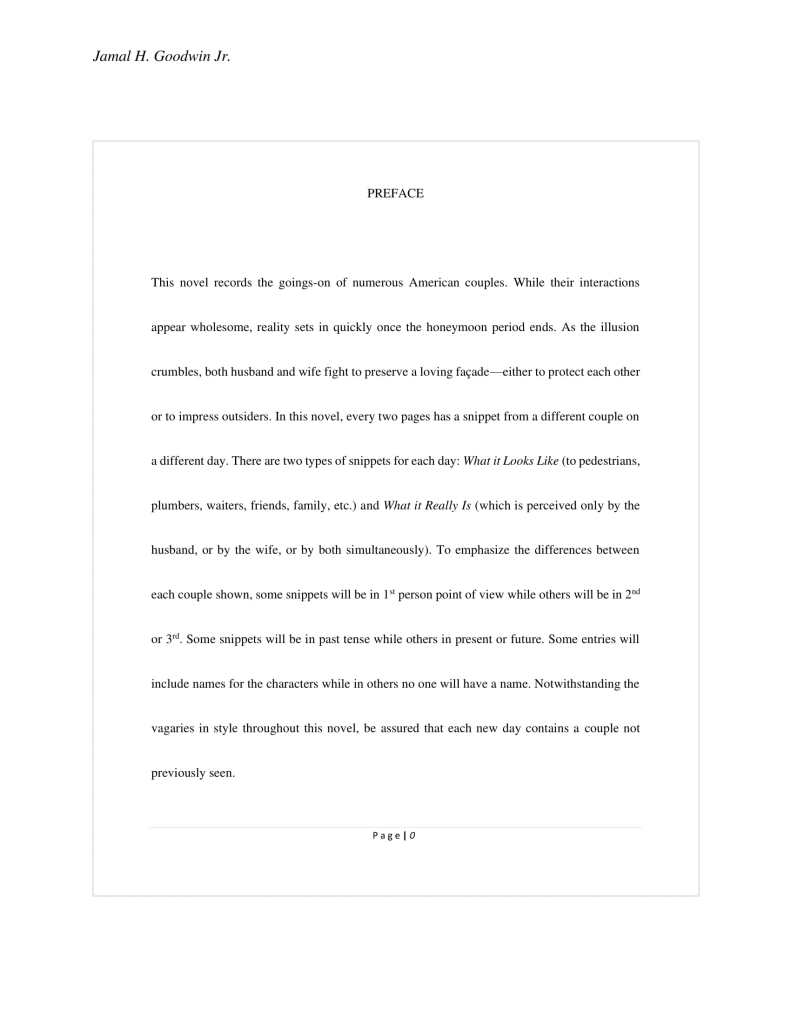
Modifying prose isn’t the only way to create noteworthy fiction. Yes, plain style with its mostly simple sentences differs heavily from grand style, which is used in speeches, or purple prose, which imitates poetry. The format of a story, be it traditional or something unique, like a letter (epistolary fiction), effects the reading experience just as much if not more than syntax.

In my fall 2020 semester, I wrote a story in my usual middle-sometimes-purple style, but tried something new and used the format of reference fiction. It mimics an encyclopedia.

The title of this story comes from one of my favorite books: Chemistry by Weike Wang. On page 52, she uses the line, “Still we fight beside clothing racks.” It’s a metaphor for a couple; they are arguing but not seeing one another. The fight is obscured. Intentions are misunderstood.
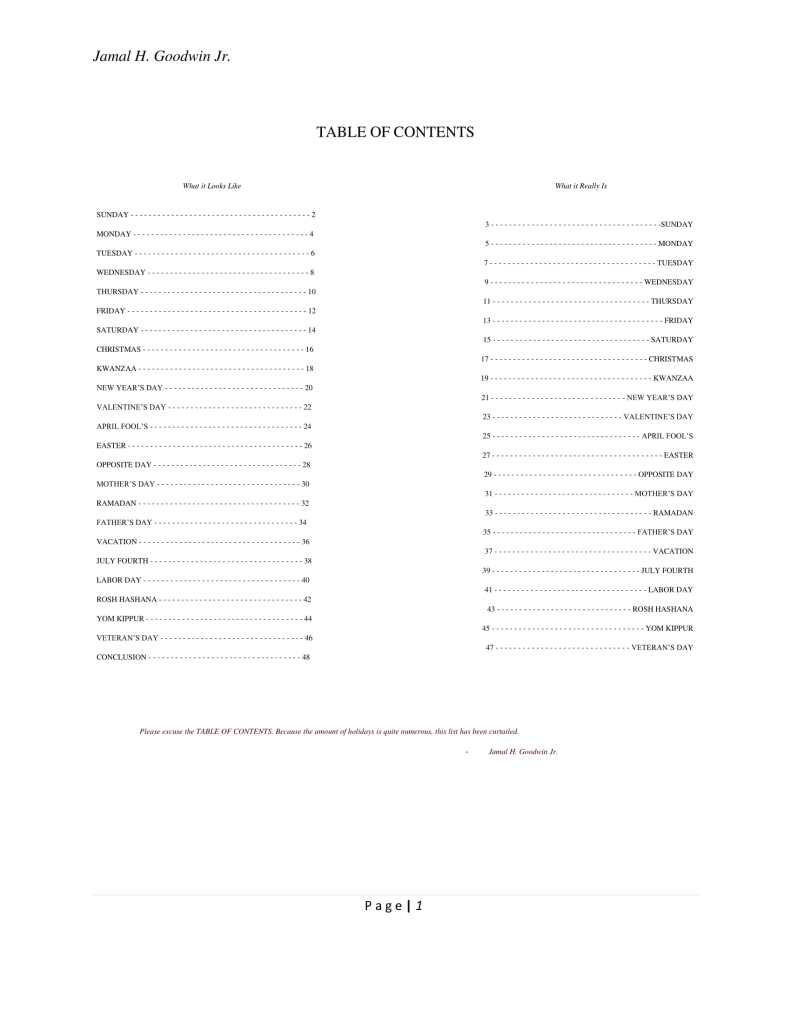
What it Looks Like

SUNDAY

            Before she can even reach the kitchen, she is reached to by the hand of the memories. Stubby. Recent and innocent, like a baby, like the one she will bear in some months. The three of them were talking an hour ago: her, her husband, and the little one, stirring inside her. Her husband had insisted on doing the dishes, saying she should rest after cleaning all Saturday. She had been eating a sandwich and laughed between bites. He joked that with all the baby clothes she had bought, she was too ready to be a mother, and she said he’d become a helicopter dad before he knew it.

           She is returning to the kitchen to munch on some Oreos. She deserves to treat herself. She walks on the carpet she vacuumed smooth yesterday and walks past the couch she dusted. But when she enters the dining room, her husband calls out to her from the bedroom. He asks, politely, can she iron his dress shirt? She smiles. He’s just woken from a nap, and she remembers that he’s got an important brunch at work tomorrow. She assures him his clothes will be ready, and she fetches his best shirt to iron for him.

P a g e | 2

What it Really Is

SUNDAY

           She walks atop the clutter at this point. Her head is in that daze again, responsibilities flickering by like stills from film tape, responsibilities flickering by and she can latch on to none of them, she’s stressed again, she can feel another one coming on: a panic attack. Her breaths hasten because the crumbs she vacuumed off the carpet yesterday and the clothes pile she had folded this morning have reverted back to their sickly forms. In an environment like this, where urine reeks from behind the toilet and kitchen grease clings to the walls in the living room,  where she is the only one who acknowledges habits need to be changed, how can she raise a baby?

           She slumps against the kitchen wall, desperate for something to ease her mind. She whips her head to the right. All that remains in the cupboard: a nearly empty box of Oreos. She palms a few.

           But before she can chew them, her husband shouts, Can you iron somethin’ for me? I’ve got a brunch with the guys at work tomorrow.

P a g e | 3

MONDAY

            “I was checking the inboxes, like she asked me to. Then she went around and told Charles I abandoned his assignment. When she’s the co-supervisor. What kinda nonsense—!”

            And as she talked, Rosie saw the sadness creep on Daniel’s face. Deep wrinkles eked along his aged forehead; maggots, she called them when she was mad. But she wasn’t mad, no. Not in this moment. She was yelling but she, too, was sad, and Daniel, seeing this sadness, grew mad, mad with a rage that glowed from his squinted eyes, but he didn’t burst, he wouldn’t explode, he just nodded, awaiting a chance to speak, to assuage his ailing wife, knowing that helping her is better than vengeance towards her coworker.

            “That girl is twenty years than me. She should show some respect. Don’t you agree dear?”

            And she could tell that her words had torn Daniel. He never liked to see her so worked up, but he knew he had to give her space to express herself.

            And so he agreed.

P a g e | 4

MONDAY

            And as Rosemarie talked, Daniel’s frustration nearly boiled over. He didn’t process a word of her ranting. Instead, he perused her weaknesses. How many times had he pleaded with her to just get another job? He had lost count. Paul and Aaron fled as soon as they reached adulthood; they didn’t visit unless they were certain she was using a vacation day. From a young age they learned to pity their mother. If it wasn’t because she was overloaded with spreadsheets, it was the coworkers nitpicking behind her back. The common denominator? Sitting in a cubicle surrounded by a bunch of jerks.

            He didn’t feel the tight folding of skin on his forehead, but the growing tears stung his eyes. Rosemarie dug her elbows into her thighs, gripping her chin between her palms. She was shouting something or other. She would lose that songlike voice of hers, the one that elicited the smile of passersby. So often, strangers would greet her like a dear friend.

           Why not apply to be a flight attendant? You would make a great stewardess. Or you could go back and get your degree, become a physical therapist. Daniel had made many pleas to her over the years. She had just waved them off. By choice or by accident, Rosemarie had been groomed to key excel sheets and do customer service.

            A “Don’t you agree dear?” broke his train of thought.

            With a dense sigh, he nodded.

P a g e | 5

SATURDAY

            Date night! But we’re not like other couples. Hubby and me watch bad movies. It’s so fun! Last time, we watched The Last Airbender. Cute kid, but his arrow wasn’t even blue. And they called him “Ahngh,” like a weird grunt or something.

            Tonight we watched Independence Day: Resurgence. Boy was that crappy! The blonde scientist guy, getting probed by the floating robotic ball. What were those writers thinking? I think I waited the whole movie to see Will Smith, but all we got was his discount son, looked nothing like the real dude.

P a g e | 14

SATURDAY

           We were supposed to host a movie night with friends. And… the idea was to watch something that we both would like… But of course that never happens. He always talks over me and we ended up watching the worst movie of the 2010s. He’s got this penchant for shitty movies, it irks me to no end. I couldn’t just come out and tell people that though, tell them he made all the decisions in the relationship. So “why not,” I said, and said I wanted to watch it, and told the gang watching bad movies was something we always did. I think my act was pretty convincing, though everyone left before the climax. I was stuck watching the rest with him. They ate all the popcorn, he devoured the nachos and salsa, and there were no hoagies left to eat. We sat on that couch til the last credits line scrolled by, at 2:13 AM.

P a g e | 15

CHRISTMAS

            We sit at an orange and beige checkered table, the light from stained glass descending behind us. Glossy and pink, the marble floor glows.

           I knew Jasmine wasn’t in the mood for Chinese, and she falls into depressions during the Christmas season, so I stepped up and brought her here: El Vino de Reyes.

           We pick up our menus. A plastic flap covers the text; surrounding the items are clumps of crimson dust fixed into shapes, like flowers and stars.

           Each waiter who passes us nods and says, Cómo estáis? Finally, we can feel not broke! Jasmine loves it… I know she does. The way she beams at me as I fork bits of salad; the mirth with which she stirs her quinoa; the knife’s ding on her plate as she cuts slices of flan.

           Her grimace had faded, and she stopped looking out at the holiday lights and snowy Christmas tree across the street. This was our time.

P a g e | 16

CHRISTMAS

            I love Jasmine, and I know she’s an atheist, but she couldn’t be bothered to spend this night with me and my parents. I tried to hide my disappointment. She was too elated to pay attention. We both love Spanish food, so El Vino de Reyes was the perfect place to cheer her up. Pricey, but “Chipotle doesn’t cut it,” she had frequently reminded me.

            The holiday season thrusts her into depressions. Usually, her jokes brought light to my day, but when she’s like this I must be the one who does the shoulder carrying.

           Maybe this is a good thing. My parents never understood Jasmine’s eccentricities. They’re still baffled I married an atheist. “You can’t choose who you fall in love with,” I told them.

            Every so often, she looks up from her sugary quinoa. Her smile is radiant. I try to enjoy my paella, but I can’t help but think of the agony my wallet’s going to suffer once the bill arrives.

P a g e | 17
To Although With Haste

Charlie boards the train. She does not know where she is going. To exit the cavern of the subway requires exiting the car of the train, which can only be accomplished by escaping the catacombs of her mind.

She slumps on her bookbag. Tunnel lights strobe-light past, and at each flash Charlie winces. To although with haste, she is thinking. To be the contrarian instead of the pacifist. What does that require?

The Central Street train’s passengers are sparse today. Across from Charlie are three empty seats, and beside those empty seats are more empty seats. She thinks she saw a mother and two kids at the car’s beginning. Where is the father? Busy at work? No. More likely he wasn’t in the mood to watch the kids, so he pawned off another job to his wife, feigning gratitude, and she, lovingly obliged to her husband, never thought to protest. Never thought what she wanted.

The train passes a few stops. People board, people exit. Charlie realizes she cannot stay in this ennui forever. Not even if she wanted to. But how to remember? Rage remembers.

In rage she could remember his wrinkled brow, mirth leaking from his cheeks as his curled lips uttered “That won’t be necessary.” He skirted through the door she held open for him, his friends already seated in the car. She only had time to say “Okay, have fun tonight.” He was in good spirits that day. But many lonely nights prior she stood by his side, taking in his sadness and emptying her spirits to fill his soul. She was his Dasani bottle. Pristine at first, reused for years for various drinks, never washed, accumulating pulp and sludge, the plastic crumpled, and only used when necessary.

But when sunbeams inevitably cleansed her, she’d wave to him in passing, her mind still trained in the habit of politeness.

What would have happened if she had acted differently? In the first place, that would require her physio-psycho-framework be entirely different. From birth she would need to be constructed with cells of bravery, not timidity. Her fingers would need to be longer, her pointer finger jagged like a knife to add emphasis to her “No.” She would be 1 ft and 1 in taller, so her weight would distribute evenly on her hips, instead of guys telling her she was a lop-sided cupcake. When she spoke her voice would echo, would shove the chest of listeners, so they would know to stand back and pay attention. As it was currently, he talked over her frequently.

She would need thicker hair to impress other women and boost her ego. She would need confidence in her bones, so her body type wouldn’t matter; what would matter was bringing her body wherever she wanted and using it to do whatever she wanted. Had she had these things, things would have been different. But just what would the different be? “No, I’m coming with you,” Charlie could have said. But then he would have made fun of her. He’d call her that word she didn’t like, that all men used as a hose to put women in order.

The train slows to a stop she does not know, so she disembarks. Charlie exits the station, crosses a roofed bridge, descends some stairs, and arrives at a dock. She walks to the edge of the planks and sits, lets her legs dangle. To her left and right are boats of various shapes and sizes. They bobbed peacefully atop the water. The green water. What dirt, seaweed, or life shuttled around in the depths? Charlie could only imagine. In the distance is a jet ski which leaves ripples that travel all the way to her. She’d like to be as free as that jet ski.

What will she do about this listlessness? Optimism had yet to return to her. Perhaps she could dive in for a swim; exercise this ennui away. Or maybe. Journaling could help, though she’d have to fetch a used math or science notebook out her bag; that should suffice, but what if she forgot to tear out the page and she went to class the next day to have a classmate invade her thoughts? Even her dorm-mate could raid her belongings in search of math notes and discover deeply personal words.

So she dares to voice her problems aloud. To herself on this serene dock amid solemn emotions she gives each of her demons form so she can crush them. Her voice rises and falls and ends each sentence with the cut of a dagger. Why should he and other men and women and old ladies accost her, criticize her, ostracize her, knowing she’s generally obedient? Why be obedient? Be the contrarian, she says to herself. Start scuffles for no reason, just to prove dominance. At every opportunity, say “I’d agree with you, BUT…” Especially to him. Embarrass him in front of his friends. Let them see the marshmallow hide you’ve nursed back to health. Let them see HIS tears and flailing arms as he squeals and scampers back to the barn, snorting. Charlie would say, “I used to love him, although he’s quite a pig.”

Results Of The Interview

The homeless man was lurched forward again, hands-to-feet, chin-to-knees, asleep. He sat 3 ft off the wall of a diner. Opposite him was a parking garage; cars eased down the one-way street to enter or pass it. On either side of the street, pedestrians ambled, oblivious to me and the sleeping buffoon. Despite his earth brown skin and dark clothes, from a distance, he chucked light like a comet. His ability perturbed me, for I was unsure of just what was blinding me. Was it the torn, overturned, Styrofoam containers, glistening white in the city morning? His pale, disfigured Nikes and mismatched socks? The orange-green substance usually beside or in front of him that hopefully wasn’t what I thought it was?

I could never look right at him. Why would you stare at the sun? But I thought about him a lot in the brief moments our bodies shared the sidewalk. Never the big Why? or the accusations—Faker, Drug Addict, Dealt a Wrong Hand. I wanted to know, What’s Next? Obviously his dreams held some answers—for the realm of unconsciousness unsheathed spiteful swords and unmasked adorned desires—but not the full picture. Only with temperate meditation could his latent aspirations be sussed out. He had nothing but time. Surely I could rouse him into ponderance.

With one hand shielding my eyes from his glow, I used my other and yanked my cheeseburger wrap out my backpack. It was a day old, and I could always buy another. I dropped it on his back. When he continued snoring I sighed and, begrudgingly, deigned to shake him.

“Gub daye,” he said. His head rolled slowly upwards til its aim found my face. Jesus, what makes druggies talk like that?

“Hey man,” I said. I squatted to his level. “What’s up?”

Like a zombie he unraveled into a sitting position. Torso exposed, his radiance had reduced. He was just a normal man now.

“’Scuse me, do you haf a few dollars? I need sum bus monie.”

Normal enough.

“Listen, uh… sir. I have five dollars. And this cheeseburger wrap. All yours if you could answer a couple questions for me.”

He sipped on a breeze. Belly full, he smacked his chapped lips, as if assessing the air’s taste. Then he let out a long, sputtering wheeze, like a car choking on gas. I jumped back, shielding my face. I thought I’d see smoke flying around us. After a few coughs, he looked prepared to respond.

“Why, tank you. I appreceete that.” He held out his palm. The cheeseburger wrap was lying beside him. Untouched.

I ignored his hand and began my investigation.

“Where do you see yourself in ten years? Or five years. Five days?”

He blinked, his mouth agape. Before he could start, I persisted.

“Will you still be on this sidewalk? Will you find blankets? What’ll you do once the 15th street church gets shutdown? Where will you crash for the night? What are your goals? What are your hobbies? What hobbies do you want to learn? What do you want to do?”

He blinked a few more times. It wasn’t until his silence that I realized I had been shouting. While cars cruised by, passersby opposite my sidewalk stopped to gawk at me. Facing the homeless man, I flicked my eyes toward them. I did my best to keep my composure, but my fingers grew tremulous. To keep them steady I gripped my thighs. Heat waved over my face and forearms. Hairs stood on end as cold sweat splotched my underarms.

Today was Tuesday and Gary, my boss, was expecting me ten minutes ago. At Gary’s office I’d be holed up in a den with a sock on the table, dirty dishes in the clean cabinets, faucets that were caked with grime, and a wall of books so packed they were actually spilling off the shelves. The bronze floor was eclipsed by dust and muck. To this office I came every week, applying for grants on Gary’s behalf or chasing reluctant business partners. As ecstatic as I was to pick up the weekly grind, some issues dogged my plans. A bitter gathering of nuisances.

I had never missed a class, not even on those occasions Professor emailed in advance, ‘class not mandatory, attend at your own risk.’ There hadn’t been a single club meeting I skipped: not the research collaborative, not the programs board, not the wellness center’s indulgent sex and drug seminars. I was a consistent talker in class, quick to correct the mosaics professor when he confused teleology with destiny, or the sustainabilities T.A. when she said ecocentrism would better humanity. My efforts notwithstanding, not a soul thanked me for throwing myself over the line, exerting energy from my body to better their lives.

Sweat trickled down my forehead and into my eyes. The wet bits of sodium stung my sclera. I was still bent forward, facing the homeless man, but the strangers watching me lost interest and continued walking. My shaking fingers began to calm, so I let go of my thighs. I eyed the ground below me. The tiny orange and black and red dots of the off-white sidewalk. Minerals incased in concrete? What was their purpose? How did they get there?

“Mah mom told me, ‘don’t talk to strangers,’” The homeless man said. “But you look like you need a friend.”

A droplet rolled into my eye. I looked at him. He was standing now.

“Ahm Jerold. And you are?”

“I’m… a student.”

* * *

A white glare shot down from the sky and penetrated my eyelids. Closed, I saw red, and open, I saw burning white. My chest heaved with each step I made walking down 13th Street, annoyed by the May heatwave. Ironic. My furrowed brow only exacerbated the heat. And my shorts and short-sleeved shirt hardly cooled me off. Once I reached the corner of 13th and Sansom, by the fashion boutique right next to Gary’s office, which I quit, I looked down Sansom Street. At the far end of the block was the TD Bank I passed whenever I headed to work. Then there was that stretch of road cars traversed, the parking lot, the dry cleaners next to it, some back alleys, the diner across the street. Absent was Jerold. In the months since our introduction, black paint from the nearby street sign was clawed off—done I assumed by another homeless man—people gave a bag of oranges or croissants to us when they saw me against the wall, next to him, and we shared drinks while I was on my lunchbreaks.

I turned and looked down 13th Street, by the Wawa and the crochet store. College kids, construction workers, suited men, but no Jerold. I picked at the knots in my hair. Oh well. We had a good thing going. Who else would listen to my musings on cause and effect? On how the minutia of our actions cannonballed into overwhelming changes we couldn’t comprehend later on? And that’s not even mentioning quantum physics. But with the homeless man gone, I would no longer be subjected to his foul stench, which I unfortunately became nose blind to. Imagining the sick particles from his body hovering down my nasal passageways, the invisible aerosols sticking to the little hairs, bacteria of various strains, thousands of each, infecting my healthy bacteria and healthy cells—I shuddered at the totality of it. If I mulled over it long enough I would go mad.

The sun’s rays continued to seize my body. The humidity made my skin feel like sandpaper. For a man like me on a day like this, all that was left was to buy some ice cream. Just up 14th Street was a Dairy Queen. I walked to it.

Mid-step my arms got squeezed to my sides. Try as I might, my foot couldn’t move another inch, and I felt hot breath press against my ear.

A raspy voice, like a taunting phantom, said “Heeey” and I shivered. I broke from his embrace and pushed him back a few feet.

“Hey! Watch your grip. What did I tell you about touching elbows?”

Jerold laughed mischievously.

“Sorey man. My bad.” Without blinking he asked, “What’s fer lunch today?”

I brushed off my shoulders fervently—a vain effort. Whatever sickness traveled with him had long infected my body. By now I was probably immune.

“Today we’re getting Dairy Queen. In the mood for a sandwich?”

He nodded. So we made our way there. People still stared when they saw me with him. Some looks of contempt, some of shock, some of respect, a couple of disgust. But what did it matter? It wasn’t like I did anything wrong. I even left him ten dollars whenever we parted. What he did with that money I didn’t know or care.

We reached the DQ and I waited for him to open the door for me. He smiled dumbly, and I wondered why telepathy couldn’t be a thing, why people required so much prodding to get anything done. I opened it and we walked to the counter. After we placed our orders we took the first booth by the window.

“So,” Jerold started. “Anything new you’re up to?”

I looked up from my folded hands.

“Of course. One always must maintain vigilance. The worlds of knowledge never sleep.”

He smiled.

“How is yor college going?”

“Good.”

Jerold was silent, expecting me to say more. I sighed.

“I’ve a semester left til I get my degree. BA in technical writing. The knowledge bus stops along the way were enjoyable, but nothing would please me more than having the ordeal concluded. Classmates can be quite petulant.”

“But I thought you biked to school?”

“No, Jerold. Knowledge bus stops. It’s a metaphor.”

“Oh.”

The store became a bit noisier. I looked toward the front counter. High school kids were gathered there, noisy and lackadaisical like I’d expect. They stared at the homeless man.

“And you, Jerold?” He looked at me, broken from a trance. “What future plans do you have? Have you devised a plan to get a home? A steady income source?”

He shook his head.

“By the way, have any monie? Maby, fifthteen instead of ten? Have a twonie?”

“No, Jerold. You can’t. My fee to you is one of pittance. It’s also incentive to keep you around.”

“Buht please!”

A woman at the front called out our orders. I walked up, took them, and returned to the booth. We both got hoagies and ice cream. My vanilla scoop with rainbow sprinkles sat in a cup. The push of my tongue against my teeth while saliva secreted from glands left, right, and above… how crass. But I couldn’t help myself. The divots imprinted along the scoop’s bottom, the hard disk hugging its perimeter, its smooth circular top, dotted with bright sprinkles—I lunged with my spoon, a carnivore grin spread from ear-to-ear. So crass. Eating dessert before the main course. Jerold picked at his strawberry scoop, staining his gray beard pink.

“Buht, man. How will I get around? I got-, I got-” His eyes flicked to the ceiling. They ticked left and right. Just as quickly he dropped them on me. “I got ta visit my family!”

Some snickering came from the side of the room. The high school kids were bunched at a table, not even trying to conceal their amusement. Let them laugh.

“You don’t have any family.” I gulped an icy scoop. “And if you do, you still don’t. Not until you get off your bum and work. I gave you suggested readings. Who wouldn’t want to hire a smart man?”

But Jerold still looked antsy. He knew I wouldn’t give him the money, and his face shriveled like he had to pee.

“I hope you’re not going to waste that ice cream,” I said.

He looked around the room and started shivering.

“Jerold, what do you do with the money I give you?”

“Hey old-head!” a snickering voice yelled. “Why you shakin’?”

I looked to side of the room. The high schoolers were becoming brazen.

The boy looked at us and said, “You got a problem? I take yo food if you don’t want it.”

A girl his table responded, “Would you stop that? He obviously don’t wanna be bothered.”

“So? He up in here stinkin’ up the place, and he barely touching his ice cream.” They all chuckled.

“I think he just need to get lit up,” another boy said. “Or get some crack.”

I spooned the last of my ice cream. And with that, I was finished. If Jerold couldn’t help himself or help me, why should I help him? I grabbed my hoagie and got out of the booth. By the time I made it to the door, they were throwing trash at him. The woman at the front and her coworkers scrambled to discipline the miscreants.

I felt cooler thanks to the ice cream. Still, the heat seared my skin within seconds. I resolved to go home and eat my hoagie in comfort. As for henchman, Jerold was a lost cause, but I could always find another.

Second Sight

That was the last time I saw Mom’s smile. Now when she’s near, raspberry aura envelopes my retinas. It sways like a flag in the breeze, and perpetually manifests and evaporates.

Pitying glances, consoling words. They are more bitter or more sweet now, vibrating my earlobe, activating goosebumps. The doctor’s voice is the most harsh, coarse like a splinter-laden rug. His apologies to Mom or Dad are boulders jutted out a waterfall. Abrupt, brusque, insincere.

I feel their eyes land on me. It tickles, it hurts. When they speak I drown in the cinema they draw. An unending movie plays all the time in my mind. I am the camera and the protagonist. I lose myself in the plot. In the other characters.

But when I hear Mom say it’ll be okay, the burgundy wisp returns and dwindles. Kindness of alien light warms my insides.

Watch Closely,

Or in other words, watch actively. Don’t skim over the details; inhale them all like you do the molecules necessary for your breath. Look between the lines, or at them, whether on the micro or macro. Let the work seep into the pores of your mind, smooth as chamomile tea—warm, thick—redolent of honey, milk, and calm. It swishes in your brain, a ready jug, til it’s replete and dripping like a sponge. Soaked in idea, you can properly now give opinions on art.


Last year I took an art class and learned something I never want to forget. All my life I’ve been a writer from a family of painters and sketch artists. My most impressive drawings were some stick figure fights I did as a kid. Thus, throughout my semester, my art was outmatched by my peers who had years more experience than me. I could barely draw a still life of a chair and a cardboard box. Meanwhile, the blonde beside me who claimed her work had room for improvement had practically sculpted a rocking horse, its legs polygonal boulders, its jaw obround, its mane flowing in the wind.

Of course, though they were all talented, there was a skill hierarchy among my classmates. A brunette from across the room was excellent at point perspective, but when we got to drawing people, her human faces looked like horses. I felt that pity you feel when you realize someone’s just as bad as you are. And yet, her confidence remained unassailable. Brighter even. Matt, our professor, led us all around to examine each other’s works. When we reached the horse-human drawing, my classmate was flooded by a shower of compliments—genuine compliments. My head jerked back in surprise as she received “Nice shading!” “You did a great job on the nose,” “The angles are short, crisp, tidy.” The portrait was blatantly terrible, yet the genuine strengths mentioned were simply glossed over by my mind. Initially, I only gave her piece a glance, but my classmates had stared at it for minutes.

A different class session, I was making a drawing using charcoal, which is much more finicky than pencil. I had no shame in complaining to Matt, recounting how bad at drawing I was or how much I didn’t know. After all, I was a beginner in a class full of the advanced. In response he asked me, smug, attempting to coax an epiphany, “But just what is a bad drawing anyway?” which is the most cliché line I’ve heard uttered by a human being, but it made me realize something. Even those things which seem to lack detail, seem amateurish even, have strengths not immediately discernible. Whether drawing or writing, whether beginner or advanced, you’ll catch something you didn’t notice before if you watch closely.