
Slips Away

His wrists were curled onto the banister. They were weightless, a draped towel. The fluff of his palms connected with the cold metal. Despite this, hot sweat still formed on his fingertips. The fingers themselves were motionless, stale like an uneaten pretzel. They couldn’t move even if he wanted them to… He wanted them to. On both wrists his pulse pounded porcupines. He could grab the railing with his bare fingers, but after being motionless so long he feared they’d snap like frozen carrots. Had his wrists not been pressing against the banister, he would have leaned forward too far, falling four floors to his doom.

* * *

A pink sunset. Orange clouds, only a few, dotting an azure sky. From the roof he could still smell honey from the garden. The scent of tall uncut grass tickled his nostrils. He didn’t know it, but he was scowling. His forehead had relaxed into a folded, wrinkled position.

* * *

Nostalgia was his least favorite emotion. That’s why he was so dour in this moment. It felt like it could have been yesterday. There were no words in his memory. Only images and sensations. Two floors below in this very building, a large storage area. A giant flat cube, with smaller flat cubes in it. Each in a different color. An old iPhone on a table hooked up to speakers. A group, about a dozen, and himself, dancing. Fast. Stomping on those cubes, trailing off onto the concrete floor. A girl. Gentle fingers, clay that molded perfectly into his. She led him upstairs.

* * *

He could see her well now. Jet black hair that shot straight down from her head and stopped at the small of her back. Glistening off her hair was the pink light of the sun. She wore jeans and a loose cream-white sweater. Along the sleeves were perforated bunnies. She smiled wide, an invitation to ask her anything. He glanced at her earth brown skin. It radiated a warm aura. He could feel it, even from the short distance that separated them. This moment, he thought, was the perfect opportunity. To say something. Anything. What to ask her? He found himself staring at her eyes longer than he had realized. She looked puzzled. Perhaps he was not aware that he was quivering, so when he attempted to ask her what he wanted to ask her, she simply laughed him off. Or was she laughing with him? She must have expected him to say something, because he was silent for a long time, and he can vividly remember watching her smile melt away. After that, all he could remember was that she left.

* * *

He wished they’d stayed in the dark. There, they were equal. There, he felt self-worth.

Two Blind Men

Hills rose above the trees in Mt. Airy. McCallum St. barreled down from Glen Echo Rd at the hill’s top to Lincoln Drive at the foot of the incline. Despite its grand size, the slope’s drop was not abrupt for passersby advancing up or marching down the hill. Road bumps acted as safety nets, warning attentive drivers there was still some road to go until a turn onto bustling Lincoln Drive.

On either side of the incline were homes two-to-three floors tall. These houses were wide, front lawns lined with daffodils and colorful flowers. The homes were rectangular, slanting on the McCallum St. hill like homes in San Francisco.

A blind, elderly man aimlessly wandered uphill. He wore a tattered navy-blue jacket, a paint splotched puce green t-shirt and faded jeans. A warmth waved on him from the face down. It was a bright, cloudless day. Normally he’d sit at peace on a bench somewhere, but a darkness preoccupied him.

He couldn’t see. His cane had been broken in half the previous night, and the half stick he had left was not making a loud enough sound to see properly. Haphazard taps clacked off the ground as he hunched over, using a tool half his arm length.

Digital clicks echoed in a car as the driver squinted at his phone, trying to finish his text telling his wife how nice the weather today was. He was so focused that he sped over the road bumps on the hill, careened to the bottom, and hit a figure walking, causing a boom of cracked bones and torn flesh as the figure rolled onto the windshield. The driver’s engine sputtered and he veered into a tree.

Constituents: It’s All Been Said Before

Constituents are parts that make up a whole. Nouns, verbs, and other parts of speech combine to make phrases. A single phrase or a collection of phrases constitute a clause, and a clause or a collection of clauses form a sentence.

This is where things get interesting. Ever wonder why English speakers of various backgrounds say the same lines, like “more power to you,” “the upper hand,” and “let’s split up?” It’s because, unbeknownst to us everyday speakers, every facet of written and spoken language is a phrase. Some phrases are more common than others.

Doesn’t it fill you with Christmas spirit?

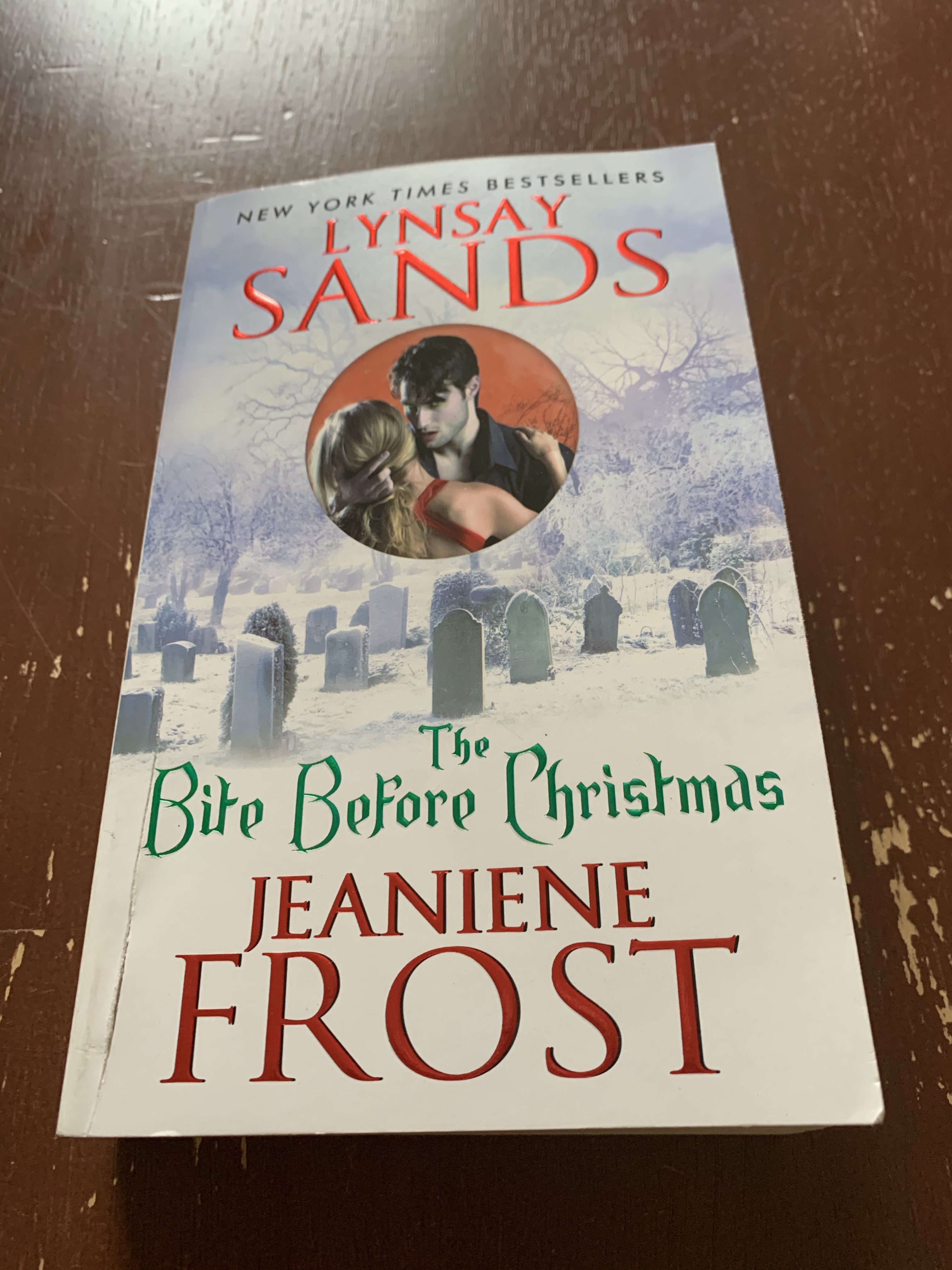
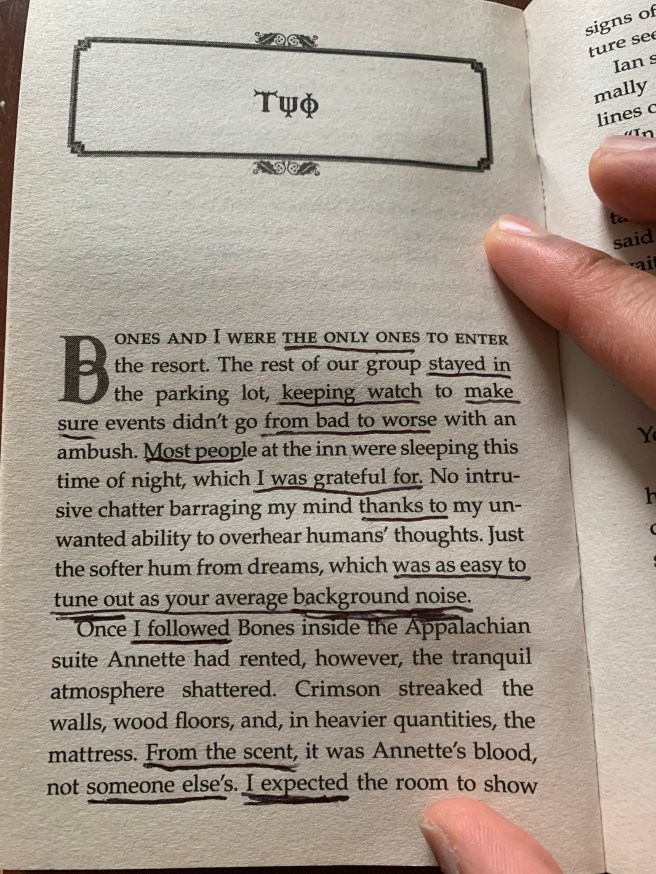
Enter Lynsay Sands and Jeaniene Frost’s The Bite Before Christmas. Cheesy title aside, it has some great examples.

Everything underlined is a common phrase. Notice “tune out” and “background noise” have a thicker marking. They are embedded in a correlative conjunction: “as easy…as”

“The only ones,” “stayed in,” “keeping watch.” These phrases aren’t as strong or well known as proverbs, but I would argue they’re more important. They are bridges to communicate meaning. If need be, they can be swapped for similar bridges to tweak the meaning or alter the cadence.

“Keeping watch” can be swapped for “looking out.” “Stayed in” for “guarded.” “The only ones” for “the only two.”

But these phrases aren’t Sands’s or Frost’s creations. The originator is untraceable. They could be us collectively, operators of the English language. How often have you said, “Me and ___ were the only ones to ___.” or “The only ones who got away with it were ___.” Phrases are underappreciated; they don’t get the acclaim a proverb like “the pen is mightier than the sword” does. Still, they are absolutely necessary, for speakers and for writers.


So how can you be original if it’s all been said before? Easy. Take something known, modify it a bit, then display it like new.

Teju Cole has a great example of phrase manipulation in Red Shift, an essay from his essay collection, Known and Strange Things. He alters the phrase “the one that you like best.”

“Perhaps your favorite film isn’t the one that you like best but the one that likes you best.”

By extending the common phrase, adding another phrase to it, Cole puts a spin on what would be a typical statement.

Writers of all kinds utilize phrases to strengthen the meaning of their words. In Canadian rapper k-os’s song, Spraying My Pen, rapper Saukrates uses several common phrases in his verses.

“Beggin’ my pardon, pardon my French but I leave you starvin’.”

“Gone til November (…)”

“(…) in the wrong department”

“Next stop is (…)”

While the last three lines buoy the verses, the first is an example of phrase manipulation. “Beggin’ my pardon” and “pardon my French” are two common phrases in one line, and they share a homonym in “pardon.” It’s effective; lyrically, it’s cool to hear the same word twice with different meanings.

To make unique or unheard of phrases requires good judgement and creativity. Phrases are context sensitive, after all. As Steven Pinker says of idioms in The Sense of Style, I say with phrases: the best use of a phrase is to put a new spin on something mundane.

Death Of A Character Exercise

I squeezed Sara to my chest. She was sandpaper rough, her arms chalk-powdered. She burned to the touch. Cracks of flesh lined her body, blood runny and bubbly. Skidded tire smell pervaded the air around us. She was alive but—God, how could I even think this—she’d be better off not. Her shut eyes were twitching. Her mouth was open and her teeth were clamped shut. Everyone outside was calling her, shouting her name, but she wouldn’t respond. Her head hadn’t turned an inch left or right since I pulled her out the house. She was in shock.

I sat on the green fire hydrant on the curb, my baby sister wrapped tight in my arms. Men sprinted past us, their red helmets bouncing on their heads, carrying hoses thick as my thigh. No one looked twice at my seat. Everyone knew this one was broken for decades. The money never came to this part of the city.

Sara stirred, she reached her left arm to touch her face. The gesture looked painful.

“Don’t move so much. You’re very hot, you need to rest.”

Her touching her own skin probably ignited her nerves. Pain from the burns, cuts opening from contracting the muscles. It was so hard to breath in there, she needs to get more air in her system before she moves at all.

She let her arm fell to her side. Her body was sweltering against my knees. She needed water. Something to cool her insides. 

“Hold on Sara. Brother’s gonna save you.”

Holding her, I ran down the block. The flames engulfed the our entire house—they were still trying to get Mom and Dad from the second floor—but they were having trouble reaching rowhomes connected to ours. I had to find a house that wasn’t hit yet. Someone would lend us some water.

When she was six Sis wanted me to teach her to play ball. Of course I said no, she was too little, too short to dribble. Not to mention the ball could hit her head. She wouldn’t stop following me though, standing behind me whenever I tried to shoot. Chasing me, trying to snatch the ball. When she was seven, I let her pass it to me before it rolled down the street. She’d start guessing my shots, “made it,” “nope.” Somehow, she was mostly right.

“I gotta teach you when you get a bit older.”

“Yeah, and I’ll kick your butt.”

Two houses didn’t answer but the third opened. A woman. I explained about the commotion, the sirens, the fire. She gave me some water bottles out her fridge and ran inside. She had some things she didn’t want the fire to destroy.

We sat on her porch, Sara in my lap. I slowly tipped some water down her throat, hoping she’d be able to swallow. She did. I put my head to her chest, her heart was beating wildly.

The cuts. I needed alcohol to clean them. I rushed up to knock on the woman’s door again. My elbow bumped against Sara’s neck. She winced, hard. Tears formed in her eyes. Then she stopped. Her teeth loosened. Her head fell back. Everything around me started going fast. My heart. The men running in the street. The porch grew wide, from ten feet to ten miles. I put my head to her chest. Then I screamed.

Recent Writing Goals

Most of my writing of late has been dedicated to my workshop story, Autumn Festival. This one by far looks to be my best work, containing a protagonist that is round and dynamic and static characters that, while sometimes flat, have personalities that excite at every dialogue line. Upon completion it will be about ten pages, 1.5 space, times new roman. It’s certainly a contest contender, especially if it is entered in a character-centric competition.

Other writing ventures include starting my sci-fi story (which is exciting, I’ll be using a particular concept I’d been saving for years) and developing my writing style. Style is something I’ve been obsessed with. A magnificent obsession. I’m experimenting in blending poetry and prose into something readable for poets and non-poets, all the while I am a non-poet. My tests are in their infant stages, but upon completion the results will be beautiful.

My thinking is, words are time-consuming. Conversely, visual arts can be scanned at a glance: in seconds someone could peek at a picture, look away and tell a stranger what they saw. Words need to be read, one by one, and after the mental or verbal pronunciation of the words, meaning must be deciphered. Reading is certainly longer than looking at a painting. However, time spent reading can either be boring, or a roller coaster of fun. Reading word-to-word has a flow that isn’t immediately discernible, unless it is a poem using rhymes or a story with literary devices (alliteration, consonance, assonance, etc.). Many who listen to poetry delight in its rhymes and imagery, the words having an audible cadence short stories lack. My thinking is, if there is some way to combine the cadence and literary devices of poetry whilst telling a narrative, without following the line-by-line stanza format, I could create an enticing style that even a non-reader would delight in picking up to read.

“Love demands expression. It will not stay still, stay silent, be good, be modest, be seen and not heard, no. It will break out in tongues of praise, the high note that smashes the glass and spills the liquid. It is no conservationist love. It is a big game hunter and you are the game. A curse on this game. How can you stick at a game when the rules keep changing? I shall call myself Alice and play croquet with the flamingoes. In Wonderland everyone cheats and love is Wonderland isn’t it? Love makes the world go round. Love is blind. All you need is love. Nobody ever died of a broken heart. You’ll get over it. It’ll be different when we’re married. Think of the children. Time’s a great healer. Still waiting for Mr Right? Miss Right? and maybe all the little Rights?”

This idea isn’t new, but it also isn’t common or popular. Only in certain circles is it prominent. Namely, the literary fiction genre (AKA, the “genreless genre”). Jeanette Winterson is known for this poetry-prose style, she uses it in her book Written on The Body. Within the first couple of pages she has a barrage of words that utilize personification, anaphora, metaphors and more. Besides frequent usage of imagery and other literary devices, it contains narration like in a short story. Winterson manages to capture so many messages in a single paragraph, her writing is just plain fun to read.

If I could interview Winterson, I’d ask how long it took to craft this paragraph of hers, and what inspired her? How many rewrites did she have? Once I finish my workshop story and get it contest ready, I will be creating passages of a similar fashion. Of course, it’ll be done in my own style.