
We Fight Beside Clothing Racks

Origin of This Piece:

Modifying prose isn’t the only way to create noteworthy fiction. Yes, plain style with its mostly simple sentences differs heavily from grand style, which is used in speeches, or purple prose, which imitates poetry. The format of a story, be it traditional or something unique, like a letter (epistolary fiction), effects the reading experience just as much if not more than syntax.

In my fall 2020 semester, I wrote a story in my usual middle-sometimes-purple style, but tried something new and used the format of reference fiction. It mimics an encyclopedia.

The title of this story comes from one of my favorite books: Chemistry by Weike Wang. On page 52, she uses the line, “Still we fight beside clothing racks.” It’s a metaphor for a couple; they are arguing but not seeing one another. The fight is obscured. Intentions are misunderstood.
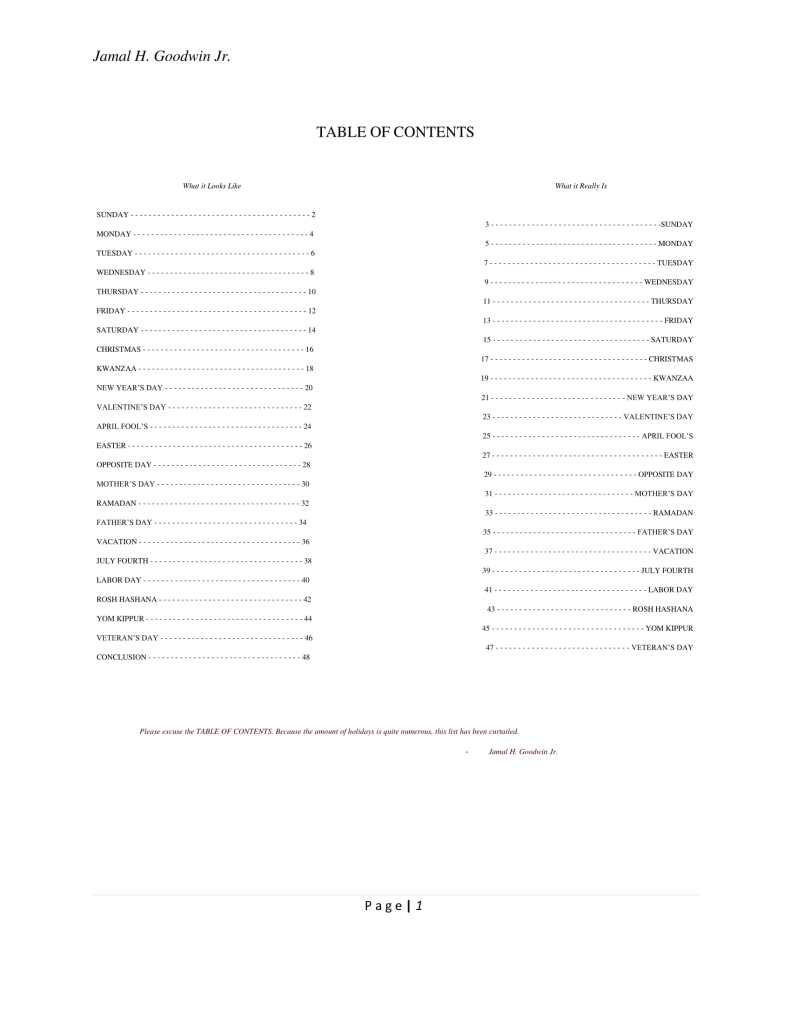
What it Looks Like

SUNDAY

            Before she can even reach the kitchen, she is reached to by the hand of the memories. Stubby. Recent and innocent, like a baby, like the one she will bear in some months. The three of them were talking an hour ago: her, her husband, and the little one, stirring inside her. Her husband had insisted on doing the dishes, saying she should rest after cleaning all Saturday. She had been eating a sandwich and laughed between bites. He joked that with all the baby clothes she had bought, she was too ready to be a mother, and she said he’d become a helicopter dad before he knew it.

           She is returning to the kitchen to munch on some Oreos. She deserves to treat herself. She walks on the carpet she vacuumed smooth yesterday and walks past the couch she dusted. But when she enters the dining room, her husband calls out to her from the bedroom. He asks, politely, can she iron his dress shirt? She smiles. He’s just woken from a nap, and she remembers that he’s got an important brunch at work tomorrow. She assures him his clothes will be ready, and she fetches his best shirt to iron for him.

P a g e | 2

What it Really Is

SUNDAY

           She walks atop the clutter at this point. Her head is in that daze again, responsibilities flickering by like stills from film tape, responsibilities flickering by and she can latch on to none of them, she’s stressed again, she can feel another one coming on: a panic attack. Her breaths hasten because the crumbs she vacuumed off the carpet yesterday and the clothes pile she had folded this morning have reverted back to their sickly forms. In an environment like this, where urine reeks from behind the toilet and kitchen grease clings to the walls in the living room,  where she is the only one who acknowledges habits need to be changed, how can she raise a baby?

           She slumps against the kitchen wall, desperate for something to ease her mind. She whips her head to the right. All that remains in the cupboard: a nearly empty box of Oreos. She palms a few.

           But before she can chew them, her husband shouts, Can you iron somethin’ for me? I’ve got a brunch with the guys at work tomorrow.

P a g e | 3

MONDAY

            “I was checking the inboxes, like she asked me to. Then she went around and told Charles I abandoned his assignment. When she’s the co-supervisor. What kinda nonsense—!”

            And as she talked, Rosie saw the sadness creep on Daniel’s face. Deep wrinkles eked along his aged forehead; maggots, she called them when she was mad. But she wasn’t mad, no. Not in this moment. She was yelling but she, too, was sad, and Daniel, seeing this sadness, grew mad, mad with a rage that glowed from his squinted eyes, but he didn’t burst, he wouldn’t explode, he just nodded, awaiting a chance to speak, to assuage his ailing wife, knowing that helping her is better than vengeance towards her coworker.

            “That girl is twenty years than me. She should show some respect. Don’t you agree dear?”

            And she could tell that her words had torn Daniel. He never liked to see her so worked up, but he knew he had to give her space to express herself.

            And so he agreed.

P a g e | 4

MONDAY

            And as Rosemarie talked, Daniel’s frustration nearly boiled over. He didn’t process a word of her ranting. Instead, he perused her weaknesses. How many times had he pleaded with her to just get another job? He had lost count. Paul and Aaron fled as soon as they reached adulthood; they didn’t visit unless they were certain she was using a vacation day. From a young age they learned to pity their mother. If it wasn’t because she was overloaded with spreadsheets, it was the coworkers nitpicking behind her back. The common denominator? Sitting in a cubicle surrounded by a bunch of jerks.

            He didn’t feel the tight folding of skin on his forehead, but the growing tears stung his eyes. Rosemarie dug her elbows into her thighs, gripping her chin between her palms. She was shouting something or other. She would lose that songlike voice of hers, the one that elicited the smile of passersby. So often, strangers would greet her like a dear friend.

           Why not apply to be a flight attendant? You would make a great stewardess. Or you could go back and get your degree, become a physical therapist. Daniel had made many pleas to her over the years. She had just waved them off. By choice or by accident, Rosemarie had been groomed to key excel sheets and do customer service.

            A “Don’t you agree dear?” broke his train of thought.

            With a dense sigh, he nodded.

P a g e | 5

SATURDAY

            Date night! But we’re not like other couples. Hubby and me watch bad movies. It’s so fun! Last time, we watched The Last Airbender. Cute kid, but his arrow wasn’t even blue. And they called him “Ahngh,” like a weird grunt or something.

            Tonight we watched Independence Day: Resurgence. Boy was that crappy! The blonde scientist guy, getting probed by the floating robotic ball. What were those writers thinking? I think I waited the whole movie to see Will Smith, but all we got was his discount son, looked nothing like the real dude.

P a g e | 14

SATURDAY

           We were supposed to host a movie night with friends. And… the idea was to watch something that we both would like… But of course that never happens. He always talks over me and we ended up watching the worst movie of the 2010s. He’s got this penchant for shitty movies, it irks me to no end. I couldn’t just come out and tell people that though, tell them he made all the decisions in the relationship. So “why not,” I said, and said I wanted to watch it, and told the gang watching bad movies was something we always did. I think my act was pretty convincing, though everyone left before the climax. I was stuck watching the rest with him. They ate all the popcorn, he devoured the nachos and salsa, and there were no hoagies left to eat. We sat on that couch til the last credits line scrolled by, at 2:13 AM.

P a g e | 15

CHRISTMAS

            We sit at an orange and beige checkered table, the light from stained glass descending behind us. Glossy and pink, the marble floor glows.

           I knew Jasmine wasn’t in the mood for Chinese, and she falls into depressions during the Christmas season, so I stepped up and brought her here: El Vino de Reyes.

           We pick up our menus. A plastic flap covers the text; surrounding the items are clumps of crimson dust fixed into shapes, like flowers and stars.

           Each waiter who passes us nods and says, Cómo estáis? Finally, we can feel not broke! Jasmine loves it… I know she does. The way she beams at me as I fork bits of salad; the mirth with which she stirs her quinoa; the knife’s ding on her plate as she cuts slices of flan.

           Her grimace had faded, and she stopped looking out at the holiday lights and snowy Christmas tree across the street. This was our time.

P a g e | 16

CHRISTMAS

            I love Jasmine, and I know she’s an atheist, but she couldn’t be bothered to spend this night with me and my parents. I tried to hide my disappointment. She was too elated to pay attention. We both love Spanish food, so El Vino de Reyes was the perfect place to cheer her up. Pricey, but “Chipotle doesn’t cut it,” she had frequently reminded me.

            The holiday season thrusts her into depressions. Usually, her jokes brought light to my day, but when she’s like this I must be the one who does the shoulder carrying.

           Maybe this is a good thing. My parents never understood Jasmine’s eccentricities. They’re still baffled I married an atheist. “You can’t choose who you fall in love with,” I told them.

            Every so often, she looks up from her sugary quinoa. Her smile is radiant. I try to enjoy my paella, but I can’t help but think of the agony my wallet’s going to suffer once the bill arrives.

P a g e | 17
To Although With Haste

Charlie boards the train. She does not know where she is going. To exit the cavern of the subway requires exiting the car of the train, which can only be accomplished by escaping the catacombs of her mind.

She slumps on her bookbag. Tunnel lights strobe-light past, and at each flash Charlie winces. To although with haste, she is thinking. To be the contrarian instead of the pacifist. What does that require?

The Central Street train’s passengers are sparse today. Across from Charlie are three empty seats, and beside those empty seats are more empty seats. She thinks she saw a mother and two kids at the car’s beginning. Where is the father? Busy at work? No. More likely he wasn’t in the mood to watch the kids, so he pawned off another job to his wife, feigning gratitude, and she, lovingly obliged to her husband, never thought to protest. Never thought what she wanted.

The train passes a few stops. People board, people exit. Charlie realizes she cannot stay in this ennui forever. Not even if she wanted to. But how to remember? Rage remembers.

In rage she could remember his wrinkled brow, mirth leaking from his cheeks as his curled lips uttered “That won’t be necessary.” He skirted through the door she held open for him, his friends already seated in the car. She only had time to say “Okay, have fun tonight.” He was in good spirits that day. But many lonely nights prior she stood by his side, taking in his sadness and emptying her spirits to fill his soul. She was his Dasani bottle. Pristine at first, reused for years for various drinks, never washed, accumulating pulp and sludge, the plastic crumpled, and only used when necessary.

But when sunbeams inevitably cleansed her, she’d wave to him in passing, her mind still trained in the habit of politeness.

What would have happened if she had acted differently? In the first place, that would require her physio-psycho-framework be entirely different. From birth she would need to be constructed with cells of bravery, not timidity. Her fingers would need to be longer, her pointer finger jagged like a knife to add emphasis to her “No.” She would be 1 ft and 1 in taller, so her weight would distribute evenly on her hips, instead of guys telling her she was a lop-sided cupcake. When she spoke her voice would echo, would shove the chest of listeners, so they would know to stand back and pay attention. As it was currently, he talked over her frequently.

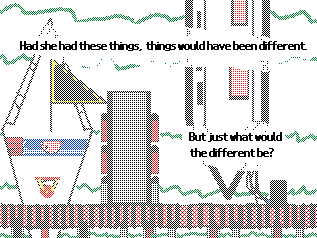
She would need thicker hair to impress other women and boost her ego. She would need confidence in her bones, so her body type wouldn’t matter; what would matter was bringing her body wherever she wanted and using it to do whatever she wanted. Had she had these things, things would have been different. But just what would the different be? “No, I’m coming with you,” Charlie could have said. But then he would have made fun of her. He’d call her that word she didn’t like, that all men used as a hose to put women in order.

The train slows to a stop she does not know, so she disembarks. Charlie exits the station, crosses a roofed bridge, descends some stairs, and arrives at a dock. She walks to the edge of the planks and sits, lets her legs dangle. To her left and right are boats of various shapes and sizes. They bobbed peacefully atop the water. The green water. What dirt, seaweed, or life shuttled around in the depths? Charlie could only imagine. In the distance is a jet ski which leaves ripples that travel all the way to her. She’d like to be as free as that jet ski.

What will she do about this listlessness? Optimism had yet to return to her. Perhaps she could dive in for a swim; exercise this ennui away. Or maybe. Journaling could help, though she’d have to fetch a used math or science notebook out her bag; that should suffice, but what if she forgot to tear out the page and she went to class the next day to have a classmate invade her thoughts? Even her dorm-mate could raid her belongings in search of math notes and discover deeply personal words.

So she dares to voice her problems aloud. To herself on this serene dock amid solemn emotions she gives each of her demons form so she can crush them. Her voice rises and falls and ends each sentence with the cut of a dagger. Why should he and other men and women and old ladies accost her, criticize her, ostracize her, knowing she’s generally obedient? Why be obedient? Be the contrarian, she says to herself. Start scuffles for no reason, just to prove dominance. At every opportunity, say “I’d agree with you, BUT…” Especially to him. Embarrass him in front of his friends. Let them see the marshmallow hide you’ve nursed back to health. Let them see HIS tears and flailing arms as he squeals and scampers back to the barn, snorting. Charlie would say, “I used to love him, although he’s quite a pig.”

Second Sight

That was the last time I saw Mom’s smile. Now when she’s near, raspberry aura envelopes my retinas. It sways like a flag in the breeze, and perpetually manifests and evaporates.

Pitying glances, consoling words. They are more bitter or more sweet now, vibrating my earlobe, activating goosebumps. The doctor’s voice is the most harsh, coarse like a splinter-laden rug. His apologies to Mom or Dad are boulders jutted out a waterfall. Abrupt, brusque, insincere.

I feel their eyes land on me. It tickles, it hurts. When they speak I drown in the cinema they draw. An unending movie plays all the time in my mind. I am the camera and the protagonist. I lose myself in the plot. In the other characters.

But when I hear Mom say it’ll be okay, the burgundy wisp returns and dwindles. Kindness of alien light warms my insides.

Watch Closely,

Or in other words, watch actively. Don’t skim over the details; inhale them all like you do the molecules necessary for your breath. Look between the lines, or at them, whether on the micro or macro. Let the work seep into the pores of your mind, smooth as chamomile tea—warm, thick—redolent of honey, milk, and calm. It swishes in your brain, a ready jug, til it’s replete and dripping like a sponge. Soaked in idea, you can properly now give opinions on art.


Last year I took an art class and learned something I never want to forget. All my life I’ve been a writer from a family of painters and sketch artists. My most impressive drawings were some stick figure fights I did as a kid. Thus, throughout my semester, my art was outmatched by my peers who had years more experience than me. I could barely draw a still life of a chair and a cardboard box. Meanwhile, the blonde beside me who claimed her work had room for improvement had practically sculpted a rocking horse, its legs polygonal boulders, its jaw obround, its mane flowing in the wind.

Of course, though they were all talented, there was a skill hierarchy among my classmates. A brunette from across the room was excellent at point perspective, but when we got to drawing people, her human faces looked like horses. I felt that pity you feel when you realize someone’s just as bad as you are. And yet, her confidence remained unassailable. Brighter even. Matt, our professor, led us all around to examine each other’s works. When we reached the horse-human drawing, my classmate was flooded by a shower of compliments—genuine compliments. My head jerked back in surprise as she received “Nice shading!” “You did a great job on the nose,” “The angles are short, crisp, tidy.” The portrait was blatantly terrible, yet the genuine strengths mentioned were simply glossed over by my mind. Initially, I only gave her piece a glance, but my classmates had stared at it for minutes.

A different class session, I was making a drawing using charcoal, which is much more finicky than pencil. I had no shame in complaining to Matt, recounting how bad at drawing I was or how much I didn’t know. After all, I was a beginner in a class full of the advanced. In response he asked me, smug, attempting to coax an epiphany, “But just what is a bad drawing anyway?” which is the most cliché line I’ve heard uttered by a human being, but it made me realize something. Even those things which seem to lack detail, seem amateurish even, have strengths not immediately discernible. Whether drawing or writing, whether beginner or advanced, you’ll catch something you didn’t notice before if you watch closely.

Nostalgia Knots

In the dim light, black dust drifted just above the floor of the shop. Specks of it crept from nowhere and vanished just as quickly—twirling and hovering about. They lingered by a red armchair that awaited the day’s clients. Clumps of it littered the floor around the chair, Clumpy knots fastened by thousands of curls. Their umbral shade was imposing. Olive fragrance emanated from them, mingling with the shop’s cologne and worn shoe smell. The curtains were closed, and the lime walls had three paintings fixed on their concrete surface: a dark-skinned DJ and a woman dancing; puzzle pieces approaching completion; an onyx continent unfurled across white-blue foam.

The owner swept silently. Paint chipped blades gyrated from above, and that black dust evaded capture. Besides swipes from the broom and the fan’s thrumming, it was dead quiet. A lamp beside the desk mirror lit the shop and accosted gray light peering through the curtains. Facing the desk, atop the console table, a flat screen droned, mute, playing a court skit from The Richard Pryor Show.

The owner managed to get some large clumps off the floor. Other pieces were spread out or stuck on the tiles. It was tougher than usual, his shoulders stiff from a bad night’s rest. He hoped the day’s clients had stories to tell.

Bells chimed as the glass door swung open. “Hey, Mr. Tristen.”

Phillip turned and straightened his back, searching for the unscheduled entrant. It was a young man, his hair in a fade that’d been curled with a twist sponge. A thin jacket sagged on his shoulders. It was carbon around the abdomen, lead from the chest up, the inside collar vermillion. He knew that jacket.

“Heyo, Bobby!” He let his broom thwack against the wall and gave him a pound. “What’s good young brother? You’ve had a growth spurt.”

“I know, I know. I’m thirteen now.”

“Thirteen? Boy, you done grown so tall. You not done yet?”

Bobby laughed, his face folding into a crescent so familiar to Phillip. Phillip turned, eyeing his unkempt floor and his muted TV.

“You come for a cut Bobby? Your hair’s already fresh. Sit your jacket off, I can shape you up.”

“No Mr. T. Just wanted to catch up. Haven’t seen the place in a minute.”

He walked around Phillip to the TV, then scanned the milkcrate of books below and beside it.

“You always had good reads,” he said. “Remember that book of world records?”

“Yeah. They weren’t records. More like world’s weirdests. Ripley’s Believe it or Not.”

“Like that woman with the fingernails?”

“Pshh, don’t remind me. Every step she’d take would make the ground screech like a chalkboard.”

Bobby picked up one book at a time. He opened, flipped through, saw just about all the pictures, then set it back. He turned to Phillip.

“I could bring chalk if you want. Could scrape some on your window. It’ll be like she’s here to visit you.”

Phillip marched over and waggled a fist.

“Now I’ll beat your butt if you do that.”

“Are you sure? I know you love screeching noises.”

The two giggled, wrinkles tight on their mouths and foreheads. Laughter bounded from wall-to-wall, filling the soundless shop with life. When it quieted, Phillip decided the day was young and he ought to have some sound instead of his mental acrimony. He unmuted the TV.

“So Mr. Tristen, how the customers treatin’ ya?”

“Oh you know. Same stuff as always…” he said, walking towards the entrance. He adjusted the curtains to let in natural light. On the windowsill was a ceramic pot. It was coil shaped and painted blue, shiny in the light. Potted in it were bamboo stalks—for good luck.

“…every time I’m giving one guy a cut, another comes in fifteen ahead of schedule. Like they shouldn’t have to wait.” He shook his head. “But the funny ones. I forgive em.”

“At least no one’s causing any beef.”

“No, no fights break out here. The worst are the loiterers. I usually do appointments only, but that doesn’t stop some gutsy fool from tryin’ to squeeze in.” He hopped on the windowsill. “How about you Bobby? Breezing through your classes?”

Bobby waved a hand.

“I have to. Mom would have my head if I got anything below a B.” He paused. After clearing his throat, he stood and said plainly, “I’m moving. And not to a different neighborhood this time. We’re going to New York.”

Phillip recoiled.

“Dang, that’s a hike.” He put a hand to his chin. “You excited about it?”

Bobby shrugged. “Doesn’t make a difference, I guess. Either way I’m going to high school next year.” The two knew each other for some time, so it wasn’t hard for Phillip to see Bobby’s furtive urgency. For one, his insistence on nostalgia. Then there was his tapping foot. It tapped at this moment, to an incongruous rhythm parallel to his unspoken thoughts.

Phillip dropped his hands. “You’re nervous, aren’t you?”

His eyes shrank to marbles. He shrugged again.

Sitcom laughter rang from the TV. Richard Pryor, who was playing a Southern, racist lawyer, made a failed attempt to solicit evidence from a ditzy and duplicitous victim; instead of saying where she was when her supposed assault occurred, she described the beginning of Alice and Wonderland.

Bobby’s home the last three years was a cramped, rented space. It was a rectangle: two floors, vertical, and as narrow as a back alley. His parents’ plan was to save wherever possible so they could pay for his college. Phillip didn’t dare ask what the New York home was like.

Instead he made a hard blink and tried to focus. “It’s not easy. You’re not only gonna have more freedom than before, you’ll be in a totally unknown environment. My advice, start off slow.”

“It’d be easier to do that if my friends were there. I’ve never ridden a bus before, I don’t know any hangout spots in NY.”

“That’s what I’m saying. Your dad’ll show you the bus route to school. But when you have some free time, just walk around your block. Get familiar with the place and who knows. It might start to feel like home.” Bobby’s gaze began to soften. “As for friends, keep contact with the ones you got. You’re getting older. I’m sure you’ll be allowed to come back and visit.”

With a brusque exhale Bobby nodded, then eyed the room. He looked at the paintings—his favorite being the DJ, Phillip remembered—and the TV and for a few moments the red chair before he finally turned and asked, “Why didn’t you sweep up yesterday?”

“Hah, just tired is all.”

“That’s it?”

Phillip hopped off the windowsill and waltzed to his broom.

“Yup. Needed to catch up on some sleep. It’s good for your brain, you know. What’s it, around 75% of memories recorded during REM sleep?”

Bobby cocked his head. “Huh.”

“Don’t worry bout it. Stuff you think about when you’re older—my age older. Have you decided what you’re gonna do when you grow up?”

“I dunno. I could be one of those people that gets paid to play videogames. But I should just get money—for free, for being myself.”

“Seriously. What do you like to do that makes you happy?”

“Alright, alright. Well, I like to talk a lot. Kids in class like to listen to me, even the teacher sometimes. I guess I would be a lawyer.”

“That’s the ticket! You’ll be an excellent lawyer. Use that creativity of yours. Go and tell the jury a story.”

With a wide smile and between laughs, Bobby said, “Yeah. Yeah I will. Thanks Mr. T.”

Phillip dipped his head in approval. He was slightly startled when he noticed Bobby, laughing, was backing away towards the front door.

“Alright Mr. Tristen. Imma head out.”

“Okay Bobby, you take care now.”

Bobby waved and bells chimed at his opening the door.

Phillip threw a hand up and called out, “Hey Bobby. Come down to visit from New York sometime.”

The door shut.

The ceiling fan gyrated, incessantly, but it could hardly be heard. The TV eclipsed all sounds. Gusts swirled to each corner of the shop, and on the floor those black clumps bumbled liked tumbleweed. Phillip sighed and retrieved his broom. Lifting his shoulders made the joints crack but swaying them made them stiff. How would he get this hair off the floor?

Gritting his teeth, he swept.