

To Although With Haste

Charlie boards the train. She does not know where she is going. To exit the cavern of the subway requires exiting the car of the train, which can only be accomplished by escaping the catacombs of her mind.

She slumps on her bookbag. Tunnel lights strobe-light past, and at each flash Charlie winces. To although with haste, she is thinking. To be the contrarian instead of the pacifist. What does that require?

The Central Street train’s passengers are sparse today. Across from Charlie are three empty seats, and beside those empty seats are more empty seats. She thinks she saw a mother and two kids at the car’s beginning. Where is the father? Busy at work? No. More likely he wasn’t in the mood to watch the kids, so he pawned off another job to his wife, feigning gratitude, and she, lovingly obliged to her husband, never thought to protest. Never thought what she wanted.

The train passes a few stops. People board, people exit. Charlie realizes she cannot stay in this ennui forever. Not even if she wanted to. But how to remember? Rage remembers.

In rage she could remember his wrinkled brow, mirth leaking from his cheeks as his curled lips uttered “That won’t be necessary.” He skirted through the door she held open for him, his friends already seated in the car. She only had time to say “Okay, have fun tonight.” He was in good spirits that day. But many lonely nights prior she stood by his side, taking in his sadness and emptying her spirits to fill his soul. She was his Dasani bottle. Pristine at first, reused for years for various drinks, never washed, accumulating pulp and sludge, the plastic crumpled, and only used when necessary.

But when sunbeams inevitably cleansed her, she’d wave to him in passing, her mind still trained in the habit of politeness.

What would have happened if she had acted differently? In the first place, that would require her physio-psycho-framework be entirely different. From birth she would need to be constructed with cells of bravery, not timidity. Her fingers would need to be longer, her pointer finger jagged like a knife to add emphasis to her “No.” She would be 1 ft and 1 in taller, so her weight would distribute evenly on her hips, instead of guys telling her she was a lop-sided cupcake. When she spoke her voice would echo, would shove the chest of listeners, so they would know to stand back and pay attention. As it was currently, he talked over her frequently.

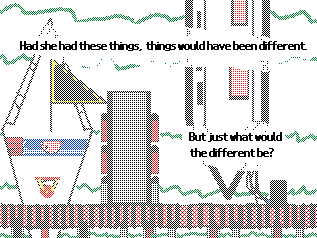
She would need thicker hair to impress other women and boost her ego. She would need confidence in her bones, so her body type wouldn’t matter; what would matter was bringing her body wherever she wanted and using it to do whatever she wanted. Had she had these things, things would have been different. But just what would the different be? “No, I’m coming with you,” Charlie could have said. But then he would have made fun of her. He’d call her that word she didn’t like, that all men used as a hose to put women in order.

The train slows to a stop she does not know, so she disembarks. Charlie exits the station, crosses a roofed bridge, descends some stairs, and arrives at a dock. She walks to the edge of the planks and sits, lets her legs dangle. To her left and right are boats of various shapes and sizes. They bobbed peacefully atop the water. The green water. What dirt, seaweed, or life shuttled around in the depths? Charlie could only imagine. In the distance is a jet ski which leaves ripples that travel all the way to her. She’d like to be as free as that jet ski.

What will she do about this listlessness? Optimism had yet to return to her. Perhaps she could dive in for a swim; exercise this ennui away. Or maybe. Journaling could help, though she’d have to fetch a used math or science notebook out her bag; that should suffice, but what if she forgot to tear out the page and she went to class the next day to have a classmate invade her thoughts? Even her dorm-mate could raid her belongings in search of math notes and discover deeply personal words.

So she dares to voice her problems aloud. To herself on this serene dock amid solemn emotions she gives each of her demons form so she can crush them. Her voice rises and falls and ends each sentence with the cut of a dagger. Why should he and other men and women and old ladies accost her, criticize her, ostracize her, knowing she’s generally obedient? Why be obedient? Be the contrarian, she says to herself. Start scuffles for no reason, just to prove dominance. At every opportunity, say “I’d agree with you, BUT…” Especially to him. Embarrass him in front of his friends. Let them see the marshmallow hide you’ve nursed back to health. Let them see HIS tears and flailing arms as he squeals and scampers back to the barn, snorting. Charlie would say, “I used to love him, although he’s quite a pig.”

These Are Lessons To Be Relearned: Self-Love And Running

Metal clanks, dumbbells drop, echoes fill the gray corridor. It’s June 2018, my first summer break from Temple. At the bicep curl machine, I recollect my expectations of freshman year and brutal reality.

For 15 reps I lift the bar, and at each hoist I tense my biceps. It feels like my max has been 40 lbs for months. Life can be so stagnant—I’m tired of it. At rep 15 I drop the weight, pull out my phone, text Dad. I tell him I’m going to start using Run 5K again.

* * *

Walking to Anderson Hall on my first day at Temple—crowds emanating from Paley Library, flocking left or right past the Bell Tower—my heart thumped, my hands quivered. Where between these people could I squeeze? I scurried to class, my cyan button-up splotched in cold sweat. 

There were attempts to make friends of course. But were they fruitful? I had a CLA introduction class and sat next to a girl. She was a part of the Temple marching band, which was cool. I was a writer. But shyness, that old impediment, thwarted every attempt at small talk I tried to make. I couldn’t get past Hi, how are you? That same year I was in a Spanish class with mostly seniors. One, who wanted to be a lawyer, was obsessed with violence and the army. We talked a lot, so I thought friendship was viable. But then he started showing me war videos that were… graphic. Heads-exploding, disentangled-spinal-cord graphic. The acquaintanceship was not sustainable. 

* * *

A text sent on a whim became axiomatic to my life. Every Tuesday and Thursday in July I rise early, wash, and trek to my neighborhood track, Germantown Field. I train with Run 5K, an old iOS app I tried in the past. At first, I can only run a few three-minute intervals (between them I take a one-and-a-half-minute walk to catch my breath). But as the weeks tick by I notice my endurance strengthening.

The runs and the exhaustion following are exhilarating. Enthralled with my sport, I begin studying form from YouTube. I learn of the forefoot strike (the preferred landing method since it lessens injuries). I discover one’s hands shouldn’t crisscross the body’s center. I realize that posture, good or bad, plays a big role in the effectiveness of a run. Incidentally, I had scheduled a kinesiology course back in April: Walk/Jog/Run. It’d be elective credits and I suppose I wanted to give myself a break. But having primed myself for stamina, an epiphany strikes me. The class would be an experience.

One morning, when I return from the track, I see my older brother in the kitchen. He says, “Mal, would you want to do the Broad Street Run?” The most populated half marathon in the country. It’s a whopping 10 miles, stretching from North Philly all the way to South. I shake my head and laugh a little. “No. I don’t even know how to run a mile.”

My second year at Temple is far better than the first. I move through crowds with loose hands, an easy smile spread to either cheek. My shoulders sit straight and my head is held high. In my self-actualized state I find new ways to better myself, like taking myself out to explore Center City; buying nice, new clothes; or approaching people to talk instead of waiting to be approached—proud whether successful or not, because I made the effort.

In Walk/Jog/Run my running improves even more. From warm-ups to breathing techniques, Professor Marshall never fails to teach us something new. These skills are useful to acquire. We are always being tested. During a class near the end of the semester, Professor Marshall gives each of us a choice. We could either run laps on the track for thirty minutes, or we could trek to City Hall and back. Although I ran about a mile or two a few times in the class’s duration, I have no idea what will happen once I reach City Hall. What if I pull a muscle and have to stop? What if I become dehydrated and get a cramp? Would my run exacerbate my recovering shin splints? The usual film reel of paranoia and fear plays in my mind, but it is quelled by my excitement. I want to try so bad, so I raise my hand and make my choice. Me and two classmates run to City Hall and back. Four miles, my longest run yet.

* * *

Starting in January 2019, I trained over the course of four months for the Broad Street Run. I attended classes equipped with my book bag and gym gear. When class was over, I would go to the campus track or run to City Hall to practice. Alongside my training, I became a member of the campus clubs Hyphen Literary Magazine and MCPB. These were large leaps from my shy Freshman self. I ran the Broad Street Run with a time of 1:38:40. Now the year is 2020 and I am preparing for a new race. The Atlantic City Rock n’roll 5K. I still face shyness on occasion, but in those moments, I remind myself of my accomplishments. If I can run a race I didn’t think was doable, if I can build confidence within myself, I know the potential for greatness will always be alive within me.