
So… Where Do Sentences Come From?

I’ve noticed something. When I’m writing, there are days when I feel invigorated—“Yes! Did you read that sentence?! I’ve got the magic touch!”—and there are days when I feel muddled—“Bah! I’m slogging through quicksand. The words just don’t sound right…”—but in either case, when I become self-aware of what I’m typing, or of the words I’m scribbling in my notebook, I ask myself: “How literally did I come up with that sentence? Like, literally, literally. (Not hyperbole literally.)”

How is my brain deciding which word to place next to the next word? There are a ton of synonyms for things. Why did my brain decide to write “It’s burning up in here” instead of “I’m burning up in here” or even “It’s too hot in here”? You might read those examples and think, “well, ‘it’s’ implies everyone’s hot while ‘I’m’ implies only the speaker is hot.” But on a conscious level, I’m not thinking of the differences at all. I have an idea that my character is sweating, and so my brain thinks of a sentence that I type onto the page. But what causes me to create one sentence and not another?

If you’re anything like me, I know what you’re gonna say, so let me stop you right there: no, the blanket statement “the subconscious mind” is not enough :P. I want to know the exact pathways of the subconscious, how the brain runs through its word binder and decides the best possible words for a situation. Or the worst words. Because the brain doesn’t give us the best sentences each go around. If it did, we wouldn’t need editors.

Unfortunately, dear readers, I am not a linguist. But as a writer and an avid grammar fan, I can recount the wonders of noticing how sentences are made, and I can speculate what it would be like if we had the power to always choose the right words.

The Art of Choosing Sentences

Here’s a helpful perspective: perhaps sentences being spoken or written unconsciously is a gift, in the same way breathing is done unconsciously. With both writing and breathing, some unknown part of us does the heavy lifting. I know I’m writing this sentence just as I know I’m breathing, but I’m not consciously doing focusing on each step. I’m not searching my brain for each individual letter, each logical part of speech, each word. All I have to do is stay on topic and the rest is guaranteed.

But in the same way manual mode with breathing allows us to meditate for calm or hyperventilate to psych ourselves up, taking conscious control over sentences allows us more flexibility, more power, and more possibilities in our prose. Take this sentence for instance: “The hat that you’re wearing looks nice.” This sentence is pretty straightforward. You might type it as a line of dialogue for a character and move forward, not giving it a second thought.

But when you do give things a second thought, you might find it outdoes the first. In the middle of typing a line of dialogue, you might pause and allow more noun and verb ideas to enter your head, or different pacings of the sentence, or unique tones of voice. You type a new sentence: “Nice hat you’ve got there,” but you want to know what else you’ve got. You toy around with it some more: “Wearing a nice hat there,” “Where can I get a hat like that?” You even go back to the original sentence but omit the “that”: “The hat that you’re wearing looks nice.”

Things get even more interesting when you factor in the different sentence types. The content of these two sentences is the same, but the order of the words changes your focus, and the use (or not) of a comma affects the cadence:

“Once I got home, I took out the trash” vs. “I took out the trash once I got home.”

In the former sentence, the crux of your attention is on the endpoint, taking out the trash, with the arrival home a backdrop to that action. The latter sentence’s focus is the reverse: we’re supposed to care about the arrival home, and the trash was just a sidenote of what happened there. Meanwhile, while writing about one of those two examples, we might consider the pacing of the sentences around it. If there are a lot of commas in a paragraph, we might choose the second variation since it lacks a comma—it would read faster, thus breaking up the pace. Likewise, in a paragraph of short, rapid-fire sentences, you’re better off with the comma version, which would give readers a chance to slow down.

These variations are by no means the end. We haven’t even factored in accents or slang! Just know, when you stop to reinvent a sentence—instead of using one as a mere tool—you can create something you’re truly proud of.

What If We Always Had the Right Words?

We all have ideas, but to articulate them? It’s tough. But imagine. Imagine writing a letter to your first crush that made them blush. Imagine writing a college essay with power words that hit like bricks and netted you a scholarship. Imagine writing a poem with the perfect rhymes, the imagery, and could convey your ideas seamlessly to listeners.

Here’s a fact about language speakers: we all more or less know our entire language. You have the same words as the president and a pop star. But the unique way each of us puts them together is what makes us, us. It’s why Chat-GTP can just mimic any person’s personality: it has access to all the words and all our unique patterns of speech, so mimicry is as easy as asking it to do so.

If we always had the right words? Well, I don’t think it would be so bad, actually. Actually, despite bringing up Chat-GTP, and I know for my fellow writers a fear may be aroused, of its neigh-inevitable snatching of our careers etc., I don’t think writing would become boring like AI prompts have become for me. (I mean, seriously, so what if it can write a description? Even if I got writer’s block and my own sentence came out sucky, at least I’d get a sense of accomplishment.)

If we always had the right words, it would be like becoming Usain Bolt. Do you think he got bored of running after he became the fastest man alive? Did he dive into a bowl of Cheetos and say “aight, I’m done now.” No! In fact, the fact that he’s excellent gives him more to work with. He can enjoy the moment of his sport and find new ways to perform—new challenges to do or places to sprint.

If we always had the right words, we would write beauty, frustration, curiosity. We would write about things we want to know and we would write about what we knew but had forgotten. We would write and feel accomplishment with each sentence, with each word. But allow me to backtrack. Because there are no right words.

Ever write a cover letter for a job? I know, I hate them too. When I write a cover letter, I often think about my word choice. It’s not enough for me to summarize where I’ve worked and why I want a new opportunity. To stand out from other job candidates, I have to write something compelling. I need a sentence that hooks the reader in immediately, and then I need sentences that can carry the momentum. A comma splice would break the magic.

And in my annoyance devising the perfect cover letter, I often think, “in all the parallel universes that may exist, some version of me has written the exact right words that the person reading this will want to hear, and that version of me is guaranteed the job.” But would it be the perfect cover letter? …No. Because someone else reading that same “perfect” cover letter may not like the writing style. Maybe the sentences are too short. And maybe a third person is okay with the sentences but may want more metaphors.

Sentence variation and metaphors are objective qualities. There’s no good or bad with them, only preferences— something that humans have. Plus, what one reader likes one day may be completely different another day, simply because of their mood.

The right words are the words that are right for you. And even that changes over time.

What are your thoughts on word choice in prose? Do you have an idea of how sentences are made? And what would you create if you could write “perfect” sentences? Tell me down below, and seeya next time 🙂

The Nine Billion Names of God – Short Story Review

The Nine Billion Names of God is a short story that speculates God’s purpose for mankind and how technology intersects with spirituality. With a total of three scenes and no particular protagonist (rather, we hop from 3rd person limited over various scientists as they interact with Tibetan monks), the author Arthur C. Clarke makes it clear that rather than character growth, the story’s events are what readers should focus on.

Throughout the story you’ll gain a sense of wonder at the monks and their planning capabilities, culture, and history, even if they tend to be vague and cocky. For instance, they gladly explain their goal with the device known as the Mark V computer—to discover and transcribe all of God’s names—but offer no explanation as to how they can tell what a “real” name is compared to other names. As you learn about the Mark V’s progress, you’ll be introduced to a captivating twist, one that will make you question the cosmic-spiritual rules of our own reality.

While character development is nonexistent, character is very present, and I’m certainly grateful for it. The monks are like poker players holding secret knowledge, and the scientists act as clueless as we feel. One scientist, who doubles as a salesman, questions just how is it that the monks know how to handle technology like the Mark V.

Another scientist name George is bored working in the monk’s temple, is anxious to leave, but his commitment to his job shows us some humanity in contrast to the stoicism of the temple-goers. There’s even humor to be found in his critiques of the monks. And in the nick of time, the scientist named Chuck arrives in the story to provide a sense of adventure.

Prose-wise, this story is written in colloquial, easy-to-follow English with a healthy amount of dialogue and narration—it’s thin on description, but objects and setting details aren’t overly important in the narrative. The lore of the story unfolds at a quick pace, thanks to a time skip, and the rules of spirituality remain consistent and left open just enough for readers to fill in some blanks with their imagination. My one complaint is that it’s never stated why God has multiple names. What, does he have a lot of nicknames or something?

Overall I think this story does an excellent job getting readers thinking. What is our purpose in the universe? Is technology a part of it? Are we even supposed to reach our purpose? If questions like these interest you, or if you like science, philosophy, or religion in general, this is the story for you.

Tom Wolfe: Substance Over Style(?)

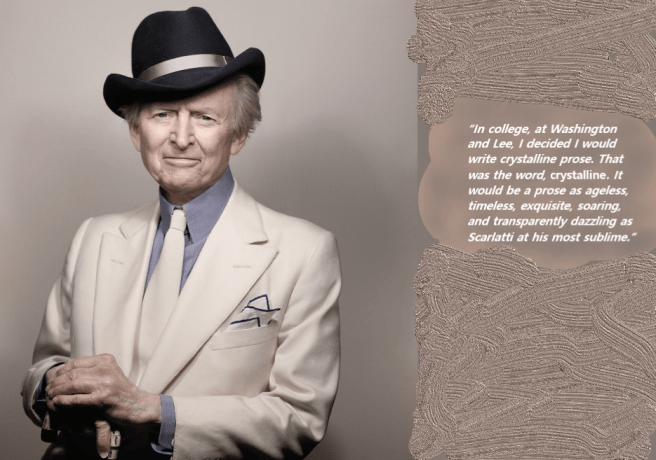
Renowned journalist Tom Wolfe says in his essay, Stalking The Billion-footed Beast, that the perfect story is 65% material and 35% writing skill, but I believe these percentages aren’t hard rules. A strong writing style can encompass 75% of what makes a story successful while material can be cut as low as 25%.

Some Definitions

Tom Wolfe’s quote: “I doubt that there is a writer over forty who does not realize in his heart of hearts that literary genius, in prose, consist of proportions more on the order of 65 percent material and 35 percent the talent in the sacred crucible.”

Wolfe was a journalist who became a novelist; to write his books, he conducted interviews, took notes on landscapes, did research… So, when he says “material” in his essay, he’s referring to the plot, the characters, and the research/inspiration behind the plot and characters. On the flipside, instead of the content of the narrative, writing skill involves the method of how the narrative is written.

When referring to writing skill, Wolfe calls a piece of writing “prose.” Merriam-Webster defines prose as “the ordinary language people use in speaking or writing.” (See the website, Literary Devices, for a more comprehensive definition!) Prose is fiction, essays, text messages, emails—anything that is not poetry. But everybody has their own writing style, and by manipulating it, prose can take infinite shapes and tones, even resembling poetry. This has drastic effects on a narrative: a simple story about waiting for the bus could be made interesting with a narrator that speaks in vivid, one paragraph sentences.

In his essay, Wolfe says he wanted his prose to be “exquisite” and “soaring” for his novel. In other words, he wanted to alter the style of his prose to be exquisite and soaring. ThoughtCo. defines style in writing as “the way in which something is spoken, written, or performed…it is broadly interpreted as representing a manifestation of the person speaking or writing.”

If we each have our own writing style then, like speech, we can change our tone, word choice, and sentence length to affect the message we convey. Think of a casual English speaker who only knows how to talk versus a voice actor who can talk high-pitched, low-pitched, sing, mumble, groan, mimic, make bird calls, etc. We shouldn’t feel constrained in a particular style; with practice, our writing can be as versatile as an actor who plays two vastly different roles.

Putting Style Over Substance Can Make Great Fiction

Here are some examples of fiction that prioritizes style much more than material. In fact, if written in a more plain style, much of the stories’ appeal would diminish.

Weike Wang’s Chemistry

If you asked me what is most memorable about Weike Wang’s novel, Chemistry, I would say it’s the writing style—easily. She uses her style to entertain us outside of plot details.

On the first page of the novel, after the protagonist is proposed to by her boyfriend, there are these lines:

The lab mate says to make a list of pros and cons.

Write it all down, prove it to yourself.

She then nods sympathetically and pats me on the arm.

The lab mate is a solver of hard problems. Her desk is next to mine but is neater and more result-producing.

Notice how the protagonist, speaking in first person, says “the labmate” instead of “my labmate.” And how Wang put “solver of hard problems” instead of “problem solver.” We follow Wang’s protagonist and meet other characters throughout the story. But instead of descriptive settings, we’re engaged by refreshing prose, prose of a style not quite human but not quite robotic. Cheeky robotic maybe.

There are other flyers posted, one that is seeking tutors in math or science.

EXCELLENT PAY, it says, DOUGH, DOUGH, AND MORE DOUGH.

I take this flyer with me. I could use dough.

To buy the things that I want.

Like pizza.

Lydia Davis’ Wife One In Country

Lydia Davis is known for her short fiction, so she makes every word count. She often makes the sum do more than the plot. In her short story, Wife One in Country, she makes a sad story lyrical and comical by her word choice: she doesn’t use any determiners (words like “the,” “this,” “that,” or “a”) and she repeats phrases multiple times close together. Here is an excerpt:

Wife one calls to speak to son. Wife two answers with impatience, gives phone to son of wife one. Son has heard impatience in voice of wife two and tells mother he thought caller was father’s sister: raging aunt, constant caller, troublesome woman. Wife one wonders: is she herself perhaps another raging woman, constant caller? No, raging woman but not constant caller. Though, for wife two, also troublesome woman.

Stories like Davis’ are a fun ride; her prose teaches us new ways English can be used. In stories like this, style is a stronger asset than material.

Donald Barthelme’s Rebecca

A final example is in Donald Barthelme’s short story, Rebecca. Like Davis’ story, in Barthelme’s story it is the narrator’s word choice, rather than a character’s, that is most memorable about the story:

Rebecca Lizard was trying to change her ugly, reptilian, thoroughly unacceptable last name.

Not only does the narrator’s personality stick out, but also how they stack three adjectives in a row. Techniques like this cannot be ignored and are done throughout the story.

Stories With Less Material Are Less Deep?

The three examples I’ve shown use clever wordplay, but the stories they are from don’t have as much material as Tayari Jones’ American Marriage, a love story that looks at race, unjust treatment of prisoners, southern culture, and more. While it does have unique elements like epistolary chapters, the book focuses much more on material than style. So does style-over-substance fiction just mean a fun read with no depth? Is material like plot, character, and setting obligated to be prioritized over a experimental or a refined, uncommon style?

No. Style will always be a significant element of fiction. Look at Raymond Queanu’s Exercises In Style, a book in which the same scene is written in 99 different styles. Look at Mark Z. Danielewski’s House of Leaves, a detective story with some pages of text rotated 180 degrees, other pages painted in an array of colors smeared from corner to corner, forcing the reader to decipher a meaning. These stylistic elements affect the reading experience far more than plot and character could, and they leave readers thinking afterward.

To Conclude: Choose Your Words Wisely

Plot, character, and setting will always be important components of a story, but within that list should be “style.” No matter how good the material, a story might be written poorly if word choice and stylistic elements aren’t used adeptly. Likewise, a shallow story can be made excellent through the use of clever wordplay.

What do you think of style? How important is it to you compared to characters or plot?