The mind, too, is a muscle. Like the opening and closing of the palm, every thought is electrical currents, a physical reaction—one that is immediate, the style of which is determined by usage and habit, like the habitual sloucher versus the sloucher who tries to sit up versus the athlete who’s developed good posture through training.
The mind, too, is a muscle, so with workouts and rest and consistency, it can grow strong, strong in any number of ways, strong like the hulking bodybuilder, the adept martial artist, the determined endurance runner, et cetera, et cetera…
When I’m reminded that the mind runs on physical reactions, I become fascinated and scared. Just living is a big responsibility, right? To be happy, we must strive to always think positive and always defeat the negative. We aren’t robots; we can’t code optimism software and let a program solve everything; it gets easier, but we must always do the work. Otherwise, the brain will turn to alternative thoughts.
Think of slouching. I used to slouch, but I never realized it: my back always felt normal. Once I saw a video of myself, I realized how I had walked through the world. I began working out and my posture improved. Some people are unaware of negative influences. If they start thinking positive and practicing self-forgiveness, the currents in their brain will run differently; their mind state will improve.
I clear space in my room when I need to reflect. I take deep breaths, recall negative thoughts I had earlier in the day, and overwrite them. I said X in my head earlier, but that’s because I felt Y. I know Y doesn’t define me. Then I look for reasons to smile. Practicing self-love is work, but it gets easier. Easier in the same way that exercising does with consistency. Eventually, it’ll become a habit.
We, English speakers, share a habit that thrives regardless of our intelligence level. It’s a habit we tend to be unaware of.
I’ve been thinking about appositives lately, how they buffer a sentence’s pace, the way they succinctly add context to a noun. It wasn’t until I took a grammar course last year that I learned the term and its function, but ever since, I see it everywhere.
Purdue University’s writing resources hub, Purdue OWL, defines appositives as “a noun or pronoun — often with modifiers — set beside another noun or pronoun to explain or identify it.”
The Purdue OWL page for Appositives
The first sentence of this post contains an appositive. Here’s another example:
Barry, a choir singer, trilled a melody for Adrienne’s, his wife’s, birthday.
(The underlined is the appositive, which renames/adds context to the pronoun beside it.)
Notice how cutting “Barry” and “Adrienne” would still leave a functioning sentence. Only, you wouldn’t know the singer or his wife’s name.
You could swap what gets kept and cut, but without the context of “a choir singer,” one might assume “Barry trilled” meant “Barry played an instrument” (instead of “Barry sang”). Cutting “his wife’s” would leave Barry and Adrienne’s relationship ambiguous.
If you pay attention to yourself or others talking, you may find yourself using an appositive without thinking about it. In fact, you’ve likely used them before you knew what they were.
Listen close the next time you’re in a conversation. You or someone else may use a grammar technique you never even heard of! Photo by PNW Production on Pexels.com
How is this possible? It’s because speech is an act of mimicry. We learn how to talk from our parents and then from the people around us. While some things are region-exclusive, like a preference for saying pop instead of soda, other things are universal, like facets of grammar/speech.
You don’t need to know what an idiom is to recognize the phrase “it’s raining cats and dogs.” Likewise, many English speakers use appositives without knowing what an appositive is. Because appositives are a speech pattern, not exclusively a written one, even people who are illiterate use them.
I think it’s humbling that we share speech patterns like appositives, conscious of it or not. We all have a beating heart and a spongey brain. The similarities in how we write and talk are just more evidence that underneath our idiosyncrasies we’re built the same.
But if we’re built from the same parts, what makes us unique? Perhaps our uniqueness emerges from the differences in how we use those parts. As English speakers, we all use appositives, but the frequency each person uses them varies. We also make our each of our uses of appositives unique by choosing specific types.
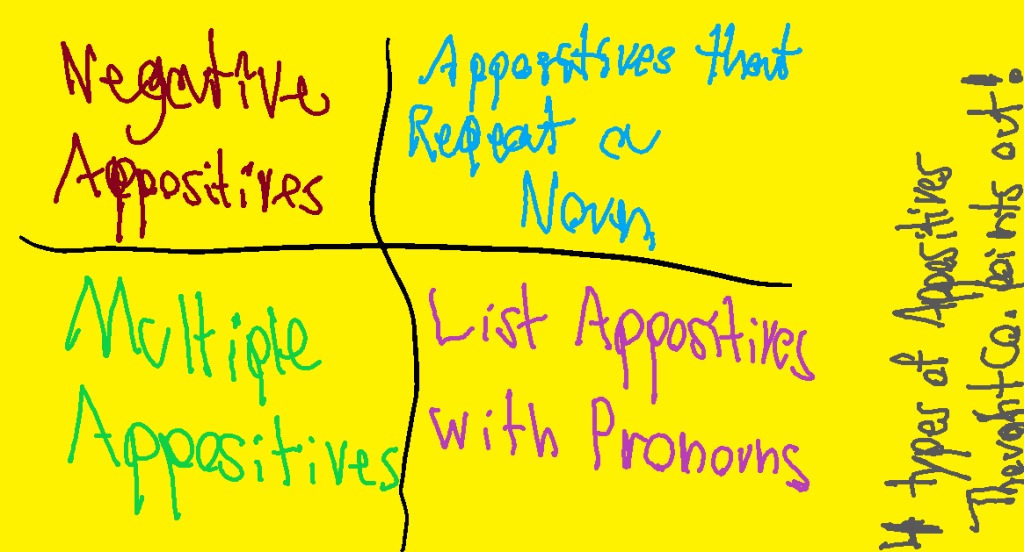
According to ThoughtCo., an education site whose writers have advanced degrees, appositives can do more than simply rename a noun with more context. They can also:
“Repeat a noun for the sake of clarity and emphasis” – Appositives that Repeat a Noun
Ex: Give Sarah my thanks, my thanks for her hospitality while we searched the hotel room.
“Identify what someone or something is not” – Negative Appositives
Ex: Teachers, rather than janitors, were expected to clean up a student’s mess in the classroom.
Appear beside a noun or pronoun two or more times – Multiple Appositives
Ex: Jimmy Strictland, manager at Pizza Hut, father of three girls, donated his extra paycheck to a Christmas charity.
Form a list that precedes a pronoun, usually the pronouns “all or these or everyone” – List Appositives with Pronouns
Ex: Taking out the trash before 9 PM, doing dishes before bed, quieting the TV while your parents are asleep—these tasks aren’t required when you live on your own.
ThoughtCo. points out more appositive variations as well, like nonrestrictive v. restrictive appositives and appositive adjectives.
There’s more too!
If you’re an English speaker, odds are you’ve used an appositive before, and you’re likely to use one again. In its ubiquity, the technique unites us, but what makes each of us unique is the variations in our usage. As ThoughtCo. proves, we have a lot of options.
What do you think of appositives? Have you heard of the technique before? How will you use the various forms in your own writing?
Metal clanks, dumbbells drop, echoes fill the gray corridor. It’s June 2018, my first summer break from Temple. At the bicep curl machine, I recollect my expectations of freshman year and brutal reality.
For 15 reps I lift the bar, and at each hoist I tense my biceps. It feels like my max has been 40 lbs for months. Life can be so stagnant—I’m tired of it. At rep 15 I drop the weight, pull out my phone, text Dad. I tell him I’m going to start using Run 5K again.
* * *
Walking to Anderson Hall on my first day at Temple—crowds emanating from Paley Library, flocking left or right past the Bell Tower—my heart thumped, my hands quivered. Where between these people could I squeeze? I scurried to class, my cyan button-up splotched in cold sweat.
There were attempts to make friends of course. But were they fruitful? I had a CLA introduction class and sat next to a girl. She was a part of the Temple marching band, which was cool. I was a writer. But shyness, that old impediment, thwarted every attempt at small talk I tried to make. I couldn’t get past Hi, how are you? That same year I was in a Spanish class with mostly seniors. One, who wanted to be a lawyer, was obsessed with violence and the army. We talked a lot, so I thought friendship was viable. But then he started showing me war videos that were… graphic. Heads-exploding, disentangled-spinal-cord graphic. The acquaintanceship was not sustainable.
* * *
A text sent on a whim became axiomatic to my life. Every Tuesday and Thursday in July I rise early, wash, and trek to my neighborhood track, Germantown Field. I train with Run 5K, an old iOS app I tried in the past. At first, I can only run a few three-minute intervals (between them I take a one-and-a-half-minute walk to catch my breath). But as the weeks tick by I notice my endurance strengthening.
The runs and the exhaustion following are exhilarating. Enthralled with my sport, I begin studying form from YouTube. I learn of the forefoot strike (the preferred landing method since it lessens injuries). I discover one’s hands shouldn’t crisscross the body’s center. I realize that posture, good or bad, plays a big role in the effectiveness of a run. Incidentally, I had scheduled a kinesiology course back in April: Walk/Jog/Run. It’d be elective credits and I suppose I wanted to give myself a break. But having primed myself for stamina, an epiphany strikes me. The class would be an experience.
One morning, when I return from the track, I see my older brother in the kitchen. He says, “Mal, would you want to do the Broad Street Run?” The most populated half marathon in the country. It’s a whopping 10 miles, stretching from North Philly all the way to South. I shake my head and laugh a little. “No. I don’t even know how to run a mile.”
My second year at Temple is far better than the first. I move through crowds with loose hands, an easy smile spread to either cheek. My shoulders sit straight and my head is held high. In my self-actualized state I find new ways to better myself, like taking myself out to explore Center City; buying nice, new clothes; or approaching people to talk instead of waiting to be approached—proud whether successful or not, because I made the effort.
In Walk/Jog/Run my running improves even more. From warm-ups to breathing techniques, Professor Marshall never fails to teach us something new. These skills are useful to acquire. We are always being tested. During a class near the end of the semester, Professor Marshall gives each of us a choice. We could either run laps on the track for thirty minutes, or we could trek to City Hall and back. Although I ran about a mile or two a few times in the class’s duration, I have no idea what will happen once I reach City Hall. What if I pull a muscle and have to stop? What if I become dehydrated and get a cramp? Would my run exacerbate my recovering shin splints? The usual film reel of paranoia and fear plays in my mind, but it is quelled by my excitement. I want to try so bad, so I raise my hand and make my choice. Me and two classmates run to City Hall and back. Four miles, my longest run yet.
* * *
Starting in January 2019, I trained over the course of four months for the Broad Street Run. I attended classes equipped with my book bag and gym gear. When class was over, I would go to the campus track or run to City Hall to practice. Alongside my training, I became a member of the campus clubs Hyphen Literary Magazine and MCPB. These were large leaps from my shy Freshman self. I ran the Broad Street Run with a time of 1:38:40. Now the year is 2020 and I am preparing for a new race. The Atlantic City Rock n’roll 5K. I still face shyness on occasion, but in those moments, I remind myself of my accomplishments. If I can run a race I didn’t think was doable, if I can build confidence within myself, I know the potential for greatness will always be alive within me.
His wrists were curled onto the banister. They were weightless, a draped towel. The fluff of his palms connected with the cold metal. Despite this, hot sweat still formed on his fingertips. The fingers themselves were motionless, stale like an uneaten pretzel. They couldn’t move even if he wanted them to… He wanted them to. On both wrists his pulse pounded porcupines. He could grab the railing with his bare fingers, but after being motionless so long he feared they’d snap like frozen carrots. Had his wrists not been pressing against the banister, he would have leaned forward too far, falling four floors to his doom.
* * *
A pink sunset. Orange clouds, only a few, dotting an azure sky. From the roof he could still smell honey from the garden. The scent of tall uncut grass tickled his nostrils. He didn’t know it, but he was scowling. His forehead had relaxed into a folded, wrinkled position.
* * *
Nostalgia was his least favorite emotion. That’s why he was so dour in this moment. It felt like it could have been yesterday. There were no words in his memory. Only images and sensations. Two floors below in this very building, a large storage area. A giant flat cube, with smaller flat cubes in it. Each in a different color. An old iPhone on a table hooked up to speakers. A group, about a dozen, and himself, dancing. Fast. Stomping on those cubes, trailing off onto the concrete floor. A girl. Gentle fingers, clay that molded perfectly into his. She led him upstairs.
* * *
He could see her well now. Jet black hair that shot straight down from her head and stopped at the small of her back. Glistening off her hair was the pink light of the sun. She wore jeans and a loose cream-white sweater. Along the sleeves were perforated bunnies. She smiled wide, an invitation to ask her anything. He glanced at her earth brown skin. It radiated a warm aura. He could feel it, even from the short distance that separated them. This moment, he thought, was the perfect opportunity. To say something. Anything. What to ask her? He found himself staring at her eyes longer than he had realized. She looked puzzled. Perhaps he was not aware that he was quivering, so when he attempted to ask her what he wanted to ask her, she simply laughed him off. Or was she laughing with him? She must have expected him to say something, because he was silent for a long time, and he can vividly remember watching her smile melt away. After that, all he could remember was that she left.
* * *
He wished they’d stayed in the dark. There, they were equal. There, he felt self-worth.
Hills rose above the trees in Mt. Airy. McCallum St. barreled down from Glen Echo Rd at the hill’s top to Lincoln Drive at the foot of the incline. Despite its grand size, the slope’s drop was not abrupt for passersby advancing up or marching down the hill. Road bumps acted as safety nets, warning attentive drivers there was still some road to go until a turn onto bustling Lincoln Drive.
On either side of the incline were homes two-to-three floors tall. These houses were wide, front lawns lined with daffodils and colorful flowers. The homes were rectangular, slanting on the McCallum St. hill like homes in San Francisco.
A blind, elderly man aimlessly wandered uphill. He wore a tattered navy-blue jacket, a paint splotched puce green t-shirt and faded jeans. A warmth waved on him from the face down. It was a bright, cloudless day. Normally he’d sit at peace on a bench somewhere, but a darkness preoccupied him.
He couldn’t see. His cane had been broken in half the previous night, and the half stick he had left was not making a loud enough sound to see properly. Haphazard taps clacked off the ground as he hunched over, using a tool half his arm length.
Digital clicks echoed in a car as the driver squinted at his phone, trying to finish his text telling his wife how nice the weather today was. He was so focused that he sped over the road bumps on the hill, careened to the bottom, and hit a figure walking, causing a boom of cracked bones and torn flesh as the figure rolled onto the windshield. The driver’s engine sputtered and he veered into a tree.








 The Fiction Writer