Mind Equals Matter

The mind, too, is a muscle. Like the opening and closing of the palm, every thought is electrical currents, a physical reaction—one that is immediate, the style of which is determined by usage and habit, like the habitual sloucher versus the sloucher who tries to sit up versus the athlete who’s developed good posture through training.

The mind, too, is a muscle, so with workouts and rest and consistency, it can grow strong, strong in any number of ways, strong like the hulking bodybuilder, the adept martial artist, the determined endurance runner, et cetera, et cetera…


Photo by Couleur on Pexels.com

When I’m reminded that the mind runs on physical reactions, I become fascinated and scared. Just living is a big responsibility, right? To be happy, we must strive to always think positive and always defeat the negative. We aren’t robots; we can’t code optimism software and let a program solve everything; it gets easier, but we must always do the work. Otherwise, the brain will turn to alternative thoughts.

In my nonfiction story, These Are Lessons To Be Relearned: Self-Love And Running, I said a classmate showed me a video of a soldier’s head coming off. He laughed. I backed away. How could someone watch something so cruel?

Think of slouching. I used to slouch, but I never realized it: my back always felt normal. Once I saw a video of myself, I realized how I had walked through the world. I began working out and my posture improved. Some people are unaware of negative influences. If they start thinking positive and practicing self-forgiveness, the currents in their brain will run differently; their mind state will improve.

I clear space in my room when I need to reflect. I take deep breaths, recall negative thoughts I had earlier in the day, and overwrite them. I said X in my head earlier, but that’s because I felt Y. I know Y doesn’t define me. Then I look for reasons to smile. Practicing self-love is work, but it gets easier. Easier in the same way that exercising does with consistency. Eventually, it’ll become a habit.

Nostalgia Knots

In the dim light, black dust drifted just above the floor of the shop. Specks of it crept from nowhere and vanished just as quickly—twirling and hovering about. They lingered by a red armchair that awaited the day’s clients. Clumps of it littered the floor around the chair, Clumpy knots fastened by thousands of curls. Their umbral shade was imposing. Olive fragrance emanated from them, mingling with the shop’s cologne and worn shoe smell. The curtains were closed, and the lime walls had three paintings fixed on their concrete surface: a dark-skinned DJ and a woman dancing; puzzle pieces approaching completion; an onyx continent unfurled across white-blue foam.

The owner swept silently. Paint chipped blades gyrated from above, and that black dust evaded capture. Besides swipes from the broom and the fan’s thrumming, it was dead quiet. A lamp beside the desk mirror lit the shop and accosted gray light peering through the curtains. Facing the desk, atop the console table, a flat screen droned, mute, playing a court skit from The Richard Pryor Show.

The owner managed to get some large clumps off the floor. Other pieces were spread out or stuck on the tiles. It was tougher than usual, his shoulders stiff from a bad night’s rest. He hoped the day’s clients had stories to tell.

Bells chimed as the glass door swung open. “Hey, Mr. Tristen.”

Phillip turned and straightened his back, searching for the unscheduled entrant. It was a young man, his hair in a fade that’d been curled with a twist sponge. A thin jacket sagged on his shoulders. It was carbon around the abdomen, lead from the chest up, the inside collar vermillion. He knew that jacket.

“Heyo, Bobby!” He let his broom thwack against the wall and gave him a pound. “What’s good young brother? You’ve had a growth spurt.”

“I know, I know. I’m thirteen now.”

“Thirteen? Boy, you done grown so tall. You not done yet?”

Bobby laughed, his face folding into a crescent so familiar to Phillip. Phillip turned, eyeing his unkempt floor and his muted TV.

“You come for a cut Bobby? Your hair’s already fresh. Sit your jacket off, I can shape you up.”

“No Mr. T. Just wanted to catch up. Haven’t seen the place in a minute.”

He walked around Phillip to the TV, then scanned the milkcrate of books below and beside it.

“You always had good reads,” he said. “Remember that book of world records?”

“Yeah. They weren’t records. More like world’s weirdests. Ripley’s Believe it or Not.”

“Like that woman with the fingernails?”

“Pshh, don’t remind me. Every step she’d take would make the ground screech like a chalkboard.”

Bobby picked up one book at a time. He opened, flipped through, saw just about all the pictures, then set it back. He turned to Phillip.

“I could bring chalk if you want. Could scrape some on your window. It’ll be like she’s here to visit you.”

Phillip marched over and waggled a fist.

“Now I’ll beat your butt if you do that.”

“Are you sure? I know you love screeching noises.”

The two giggled, wrinkles tight on their mouths and foreheads. Laughter bounded from wall-to-wall, filling the soundless shop with life. When it quieted, Phillip decided the day was young and he ought to have some sound instead of his mental acrimony. He unmuted the TV.

“So Mr. Tristen, how the customers treatin’ ya?”

“Oh you know. Same stuff as always…” he said, walking towards the entrance. He adjusted the curtains to let in natural light. On the windowsill was a ceramic pot. It was coil shaped and painted blue, shiny in the light. Potted in it were bamboo stalks—for good luck.

“…every time I’m giving one guy a cut, another comes in fifteen ahead of schedule. Like they shouldn’t have to wait.” He shook his head. “But the funny ones. I forgive em.”

“At least no one’s causing any beef.”

“No, no fights break out here. The worst are the loiterers. I usually do appointments only, but that doesn’t stop some gutsy fool from tryin’ to squeeze in.” He hopped on the windowsill. “How about you Bobby? Breezing through your classes?”

Bobby waved a hand.

“I have to. Mom would have my head if I got anything below a B.” He paused. After clearing his throat, he stood and said plainly, “I’m moving. And not to a different neighborhood this time. We’re going to New York.”

Phillip recoiled.

“Dang, that’s a hike.” He put a hand to his chin. “You excited about it?”

Bobby shrugged. “Doesn’t make a difference, I guess. Either way I’m going to high school next year.” The two knew each other for some time, so it wasn’t hard for Phillip to see Bobby’s furtive urgency. For one, his insistence on nostalgia. Then there was his tapping foot. It tapped at this moment, to an incongruous rhythm parallel to his unspoken thoughts.

Phillip dropped his hands. “You’re nervous, aren’t you?”

His eyes shrank to marbles. He shrugged again.

Sitcom laughter rang from the TV. Richard Pryor, who was playing a Southern, racist lawyer, made a failed attempt to solicit evidence from a ditzy and duplicitous victim; instead of saying where she was when her supposed assault occurred, she described the beginning of Alice and Wonderland.

Bobby’s home the last three years was a cramped, rented space. It was a rectangle: two floors, vertical, and as narrow as a back alley. His parents’ plan was to save wherever possible so they could pay for his college. Phillip didn’t dare ask what the New York home was like.

Instead he made a hard blink and tried to focus. “It’s not easy. You’re not only gonna have more freedom than before, you’ll be in a totally unknown environment. My advice, start off slow.”

“It’d be easier to do that if my friends were there. I’ve never ridden a bus before, I don’t know any hangout spots in NY.”

“That’s what I’m saying. Your dad’ll show you the bus route to school. But when you have some free time, just walk around your block. Get familiar with the place and who knows. It might start to feel like home.” Bobby’s gaze began to soften. “As for friends, keep contact with the ones you got. You’re getting older. I’m sure you’ll be allowed to come back and visit.”

With a brusque exhale Bobby nodded, then eyed the room. He looked at the paintings—his favorite being the DJ, Phillip remembered—and the TV and for a few moments the red chair before he finally turned and asked, “Why didn’t you sweep up yesterday?”

“Hah, just tired is all.”

“That’s it?”

Phillip hopped off the windowsill and waltzed to his broom.

“Yup. Needed to catch up on some sleep. It’s good for your brain, you know. What’s it, around 75% of memories recorded during REM sleep?”

Bobby cocked his head. “Huh.”

“Don’t worry bout it. Stuff you think about when you’re older—my age older. Have you decided what you’re gonna do when you grow up?”

“I dunno. I could be one of those people that gets paid to play videogames. But I should just get money—for free, for being myself.”

“Seriously. What do you like to do that makes you happy?”

“Alright, alright. Well, I like to talk a lot. Kids in class like to listen to me, even the teacher sometimes. I guess I would be a lawyer.”

“That’s the ticket! You’ll be an excellent lawyer. Use that creativity of yours. Go and tell the jury a story.”

With a wide smile and between laughs, Bobby said, “Yeah. Yeah I will. Thanks Mr. T.”

Phillip dipped his head in approval. He was slightly startled when he noticed Bobby, laughing, was backing away towards the front door.

“Alright Mr. Tristen. Imma head out.”

“Okay Bobby, you take care now.”

Bobby waved and bells chimed at his opening the door.

Phillip threw a hand up and called out, “Hey Bobby. Come down to visit from New York sometime.”

The door shut.

The ceiling fan gyrated, incessantly, but it could hardly be heard. The TV eclipsed all sounds. Gusts swirled to each corner of the shop, and on the floor those black clumps bumbled liked tumbleweed. Phillip sighed and retrieved his broom. Lifting his shoulders made the joints crack but swaying them made them stiff. How would he get this hair off the floor?

Gritting his teeth, he swept.

Appositive Perspective

We, English speakers, share a habit that thrives regardless of our intelligence level. It’s a habit we tend to be unaware of.

I’ve been thinking about appositives lately, how they buffer a sentence’s pace, the way they succinctly add context to a noun. It wasn’t until I took a grammar course last year that I learned the term and its function, but ever since, I see it everywhere.

Purdue University’s writing resources hub, Purdue OWL, defines appositives as “a noun or pronoun — often with modifiers — set beside another noun or pronoun to explain or identify it.”

The Purdue OWL page for Appositives

The first sentence of this post contains an appositive. Here’s another example:

Barry, a choir singer, trilled a melody for Adrienne’s, his wife’s, birthday.

(The underlined is the appositive, which renames/adds context to the pronoun beside it.)

Notice how cutting “Barry” and “Adrienne” would still leave a functioning sentence. Only, you wouldn’t know the singer or his wife’s name.

You could swap what gets kept and cut, but without the context of “a choir singer,” one might assume “Barry trilled” meant “Barry played an instrument” (instead of “Barry sang”). Cutting “his wife’s” would leave Barry and Adrienne’s relationship ambiguous.

If you pay attention to yourself or others talking, you may find yourself using an appositive without thinking about it. In fact, you’ve likely used them before you knew what they were.

Listen close the next time you’re in a conversation. You or someone else may use a grammar technique you never even heard of!
Photo by PNW Production on Pexels.com

How is this possible? It’s because speech is an act of mimicry. We learn how to talk from our parents and then from the people around us. While some things are region-exclusive, like a preference for saying pop instead of soda, other things are universal, like facets of grammar/speech.

You don’t need to know what an idiom is to recognize the phrase “it’s raining cats and dogs.” Likewise, many English speakers use appositives without knowing what an appositive is. Because appositives are a speech pattern, not exclusively a written one, even people who are illiterate use them.

I think it’s humbling that we share speech patterns like appositives, conscious of it or not. We all have a beating heart and a spongey brain. The similarities in how we write and talk are just more evidence that underneath our idiosyncrasies we’re built the same.

But if we’re built from the same parts, what makes us unique? Perhaps our uniqueness emerges from the differences in how we use those parts. As English speakers, we all use appositives, but the frequency each person uses them varies. We also make our each of our uses of appositives unique by choosing specific types.

According to ThoughtCo., an education site whose writers have advanced degrees, appositives can do more than simply rename a noun with more context. They can also:

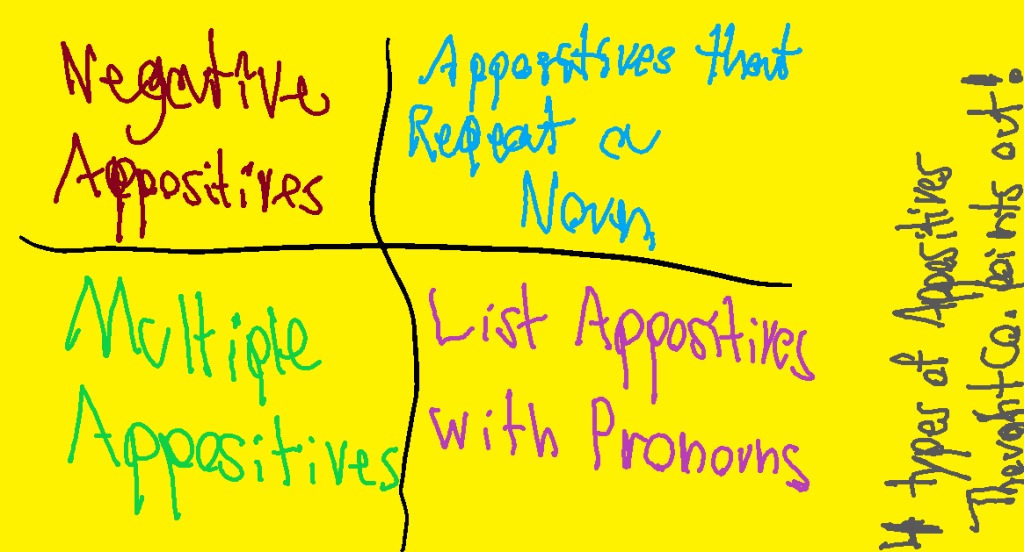
  • “Repeat a noun for the sake of clarity and emphasis” – Appositives that Repeat a Noun
    • Ex: Give Sarah my thanks, my thanks for her hospitality while we searched the hotel room.
  • “Identify what someone or something is not” – Negative Appositives
    • Ex: Teachers, rather than janitors, were expected to clean up a student’s mess in the classroom.
  • Appear beside a noun or pronoun two or more times – Multiple Appositives
    • Ex: Jimmy Strictland, manager at Pizza Hut, father of three girls, donated his extra paycheck to a Christmas charity.
  • Form a list that precedes a pronoun, usually the pronouns “all or these or everyone” – List Appositives with Pronouns
    • Ex: Taking out the trash before 9 PM, doing dishes before bed, quieting the TV while your parents are asleep—these tasks aren’t required when you live on your own.

ThoughtCo. points out more appositive variations as well, like nonrestrictive v. restrictive appositives and appositive adjectives.

There’s more too!

If you’re an English speaker, odds are you’ve used an appositive before, and you’re likely to use one again. In its ubiquity, the technique unites us, but what makes each of us unique is the variations in our usage. As ThoughtCo. proves, we have a lot of options.

What do you think of appositives? Have you heard of the technique before? How will you use the various forms in your own writing?

These Are Lessons To Be Relearned: Self-Love And Running

Metal clanks, dumbbells drop, echoes fill the gray corridor. It’s June 2018, my first summer break from Temple. At the bicep curl machine, I recollect my expectations of freshman year and brutal reality.

For 15 reps I lift the bar, and at each hoist I tense my biceps. It feels like my max has been 40 lbs for months. Life can be so stagnant—I’m tired of it. At rep 15 I drop the weight, pull out my phone, text Dad. I tell him I’m going to start using Run 5K again.

* * *

Walking to Anderson Hall on my first day at Temple—crowds emanating from Paley Library, flocking left or right past the Bell Tower—my heart thumped, my hands quivered. Where between these people could I squeeze? I scurried to class, my cyan button-up splotched in cold sweat. 

There were attempts to make friends of course. But were they fruitful? I had a CLA introduction class and sat next to a girl. She was a part of the Temple marching band, which was cool. I was a writer. But shyness, that old impediment, thwarted every attempt at small talk I tried to make. I couldn’t get past Hi, how are you? That same year I was in a Spanish class with mostly seniors. One, who wanted to be a lawyer, was obsessed with violence and the army. We talked a lot, so I thought friendship was viable. But then he started showing me war videos that were… graphic. Heads-exploding, disentangled-spinal-cord graphic. The acquaintanceship was not sustainable. 

* * *

A text sent on a whim became axiomatic to my life. Every Tuesday and Thursday in July I rise early, wash, and trek to my neighborhood track, Germantown Field. I train with Run 5K, an old iOS app I tried in the past. At first, I can only run a few three-minute intervals (between them I take a one-and-a-half-minute walk to catch my breath). But as the weeks tick by I notice my endurance strengthening.

The runs and the exhaustion following are exhilarating. Enthralled with my sport, I begin studying form from YouTube. I learn of the forefoot strike (the preferred landing method since it lessens injuries). I discover one’s hands shouldn’t crisscross the body’s center. I realize that posture, good or bad, plays a big role in the effectiveness of a run. Incidentally, I had scheduled a kinesiology course back in April: Walk/Jog/Run. It’d be elective credits and I suppose I wanted to give myself a break. But having primed myself for stamina, an epiphany strikes me. The class would be an experience.

One morning, when I return from the track, I see my older brother in the kitchen. He says, “Mal, would you want to do the Broad Street Run?” The most populated half marathon in the country. It’s a whopping 10 miles, stretching from North Philly all the way to South. I shake my head and laugh a little. “No. I don’t even know how to run a mile.”

My second year at Temple is far better than the first. I move through crowds with loose hands, an easy smile spread to either cheek. My shoulders sit straight and my head is held high. In my self-actualized state I find new ways to better myself, like taking myself out to explore Center City; buying nice, new clothes; or approaching people to talk instead of waiting to be approached—proud whether successful or not, because I made the effort.

In Walk/Jog/Run my running improves even more. From warm-ups to breathing techniques, Professor Marshall never fails to teach us something new. These skills are useful to acquire. We are always being tested. During a class near the end of the semester, Professor Marshall gives each of us a choice. We could either run laps on the track for thirty minutes, or we could trek to City Hall and back. Although I ran about a mile or two a few times in the class’s duration, I have no idea what will happen once I reach City Hall. What if I pull a muscle and have to stop? What if I become dehydrated and get a cramp? Would my run exacerbate my recovering shin splints? The usual film reel of paranoia and fear plays in my mind, but it is quelled by my excitement. I want to try so bad, so I raise my hand and make my choice. Me and two classmates run to City Hall and back. Four miles, my longest run yet.

* * *

Starting in January 2019, I trained over the course of four months for the Broad Street Run. I attended classes equipped with my book bag and gym gear. When class was over, I would go to the campus track or run to City Hall to practice. Alongside my training, I became a member of the campus clubs Hyphen Literary Magazine and MCPB. These were large leaps from my shy Freshman self. I ran the Broad Street Run with a time of 1:38:40. Now the year is 2020 and I am preparing for a new race. The Atlantic City Rock n’roll 5K. I still face shyness on occasion, but in those moments, I remind myself of my accomplishments. If I can run a race I didn’t think was doable, if I can build confidence within myself, I know the potential for greatness will always be alive within me.