My Writing: Before And After Learning Abt. Prose Style

[This Post Was Taken From A 5/31/20 Entry In My Writer’s Journal]

“I’m going to give it to you straight, writing takes effort. You can’t write a passage once a month and expect to become a major selling author. This is something I was forced to open my eyes to and something every writer should know.”

– Jamal H. Goodwin Jr., Create Before You Critique, January 2016

“My insistence on the merits of style is not meant to discount genre. Readers should know what experience they desire and be able to purchase it. But it’s undeniable that style precedes genre. Otherwise, besides plot, all detective stories would read the same!”

– Jamal H. Goodwin Jr., The Macchia of Literature, March 2020

College has done a lot of good for me. My drive to learn combined with Temple’s abundant opportunities created a mental machine, a writing windmill with infinite energy. The wheel’s turning is constant and electric. Touch and you’ll get zapped.

It’s funny how many people told me I didn’t need college to be a writer, how many people raised an eyebrow when I declared I was an English major. They said, “but you could just start your book now. You could self-publish. Write for practice and you’ll learn everything you need.”

There are many writers out there. The writing community on Twitter alone likely comprises of hundreds of thousands of people. Many are successful, and many have a degree outside of English or no degree at all.

Still, many DO have a degree. The entire world of literary fiction is dominated by pompous or reticent, avant-garde MFA holders. And unconventional knowledge of groups like OULIPO or works like Kathy Acker’s Great Expectations? I’d be hard pressed to find any normal person, any non-writer tell me about them.

And these literary works/groups aren’t trending on the internet. Everything is Stephen King or J.K. Rowling. It’d be a miracle if non-college Jamal found out about Weike Wang’s Chemistry or Alexandra Kleeman’s You Too Can Have A Body Like Mine.

I say all of this to say, my approach to writing has changed since going to college. A concrete example is my acquired knowledge on prose. It’s hard to believe I even knew that word in high school, but now that I’ve learned the rules of prose, I’ll never forget it. Poetry is poetry, and not-poetry is prose. And I must say, my prose was weaker when I was younger. I used to use or eschew commas willy-nilly, not knowing they demarcated phrases and parentheticals.

The first quote I used at the beginning of this entry is of an article I wrote for my high school newspaper. My first sentence in that quote uses a comma incorrectly; it separates two clauses, making it a comma splice, which is a type of fused sentence. The second quote is from a more recent work, and I use commas in it correctly. The line “besides plot” is in-between two commas; it’s a parenthetical. High school me had no knowledge of sentence types or basic grammar rules.

Interestingly, young-me did have some good sentences up his sleeve. What’s below comes from my fanfic of Tananarive Due’s African Immortals series:

“Dawit’s wife, Jessica, was once a mortal herself, until Dawit feared he’d lose her forever and forced the ceremony upon her.”

– Jamal H. Goodwin Jr., Teka’s Travels, December 2014

In the excerpt, before I knew what the technique was, I used an appositive (“Jessica” stands in for “Dawit’s wife”) and a subordinate conjunction and clause (“until Dawit feared…”). I suppose some grammar techniques are picked up after frequent reading/writing.

My knowledge attained thus far excites me. Knowing the names of the skills I’ve used allows me to use and not use them at will.

Nostalgia Knots

In the dim light, black dust drifted just above the floor of the shop. Specks of it crept from nowhere and vanished just as quickly—twirling and hovering about. They lingered by a red armchair that awaited the day’s clients. Clumps of it littered the floor around the chair, Clumpy knots fastened by thousands of curls. Their umbral shade was imposing. Olive fragrance emanated from them, mingling with the shop’s cologne and worn shoe smell. The curtains were closed, and the lime walls had three paintings fixed on their concrete surface: a dark-skinned DJ and a woman dancing; puzzle pieces approaching completion; an onyx continent unfurled across white-blue foam.

The owner swept silently. Paint chipped blades gyrated from above, and that black dust evaded capture. Besides swipes from the broom and the fan’s thrumming, it was dead quiet. A lamp beside the desk mirror lit the shop and accosted gray light peering through the curtains. Facing the desk, atop the console table, a flat screen droned, mute, playing a court skit from The Richard Pryor Show.

The owner managed to get some large clumps off the floor. Other pieces were spread out or stuck on the tiles. It was tougher than usual, his shoulders stiff from a bad night’s rest. He hoped the day’s clients had stories to tell.

Bells chimed as the glass door swung open. “Hey, Mr. Tristen.”

Phillip turned and straightened his back, searching for the unscheduled entrant. It was a young man, his hair in a fade that’d been curled with a twist sponge. A thin jacket sagged on his shoulders. It was carbon around the abdomen, lead from the chest up, the inside collar vermillion. He knew that jacket.

“Heyo, Bobby!” He let his broom thwack against the wall and gave him a pound. “What’s good young brother? You’ve had a growth spurt.”

“I know, I know. I’m thirteen now.”

“Thirteen? Boy, you done grown so tall. You not done yet?”

Bobby laughed, his face folding into a crescent so familiar to Phillip. Phillip turned, eyeing his unkempt floor and his muted TV.

“You come for a cut Bobby? Your hair’s already fresh. Sit your jacket off, I can shape you up.”

“No Mr. T. Just wanted to catch up. Haven’t seen the place in a minute.”

He walked around Phillip to the TV, then scanned the milkcrate of books below and beside it.

“You always had good reads,” he said. “Remember that book of world records?”

“Yeah. They weren’t records. More like world’s weirdests. Ripley’s Believe it or Not.”

“Like that woman with the fingernails?”

“Pshh, don’t remind me. Every step she’d take would make the ground screech like a chalkboard.”

Bobby picked up one book at a time. He opened, flipped through, saw just about all the pictures, then set it back. He turned to Phillip.

“I could bring chalk if you want. Could scrape some on your window. It’ll be like she’s here to visit you.”

Phillip marched over and waggled a fist.

“Now I’ll beat your butt if you do that.”

“Are you sure? I know you love screeching noises.”

The two giggled, wrinkles tight on their mouths and foreheads. Laughter bounded from wall-to-wall, filling the soundless shop with life. When it quieted, Phillip decided the day was young and he ought to have some sound instead of his mental acrimony. He unmuted the TV.

“So Mr. Tristen, how the customers treatin’ ya?”

“Oh you know. Same stuff as always…” he said, walking towards the entrance. He adjusted the curtains to let in natural light. On the windowsill was a ceramic pot. It was coil shaped and painted blue, shiny in the light. Potted in it were bamboo stalks—for good luck.

“…every time I’m giving one guy a cut, another comes in fifteen ahead of schedule. Like they shouldn’t have to wait.” He shook his head. “But the funny ones. I forgive em.”

“At least no one’s causing any beef.”

“No, no fights break out here. The worst are the loiterers. I usually do appointments only, but that doesn’t stop some gutsy fool from tryin’ to squeeze in.” He hopped on the windowsill. “How about you Bobby? Breezing through your classes?”

Bobby waved a hand.

“I have to. Mom would have my head if I got anything below a B.” He paused. After clearing his throat, he stood and said plainly, “I’m moving. And not to a different neighborhood this time. We’re going to New York.”

Phillip recoiled.

“Dang, that’s a hike.” He put a hand to his chin. “You excited about it?”

Bobby shrugged. “Doesn’t make a difference, I guess. Either way I’m going to high school next year.” The two knew each other for some time, so it wasn’t hard for Phillip to see Bobby’s furtive urgency. For one, his insistence on nostalgia. Then there was his tapping foot. It tapped at this moment, to an incongruous rhythm parallel to his unspoken thoughts.

Phillip dropped his hands. “You’re nervous, aren’t you?”

His eyes shrank to marbles. He shrugged again.

Sitcom laughter rang from the TV. Richard Pryor, who was playing a Southern, racist lawyer, made a failed attempt to solicit evidence from a ditzy and duplicitous victim; instead of saying where she was when her supposed assault occurred, she described the beginning of Alice and Wonderland.

Bobby’s home the last three years was a cramped, rented space. It was a rectangle: two floors, vertical, and as narrow as a back alley. His parents’ plan was to save wherever possible so they could pay for his college. Phillip didn’t dare ask what the New York home was like.

Instead he made a hard blink and tried to focus. “It’s not easy. You’re not only gonna have more freedom than before, you’ll be in a totally unknown environment. My advice, start off slow.”

“It’d be easier to do that if my friends were there. I’ve never ridden a bus before, I don’t know any hangout spots in NY.”

“That’s what I’m saying. Your dad’ll show you the bus route to school. But when you have some free time, just walk around your block. Get familiar with the place and who knows. It might start to feel like home.” Bobby’s gaze began to soften. “As for friends, keep contact with the ones you got. You’re getting older. I’m sure you’ll be allowed to come back and visit.”

With a brusque exhale Bobby nodded, then eyed the room. He looked at the paintings—his favorite being the DJ, Phillip remembered—and the TV and for a few moments the red chair before he finally turned and asked, “Why didn’t you sweep up yesterday?”

“Hah, just tired is all.”

“That’s it?”

Phillip hopped off the windowsill and waltzed to his broom.

“Yup. Needed to catch up on some sleep. It’s good for your brain, you know. What’s it, around 75% of memories recorded during REM sleep?”

Bobby cocked his head. “Huh.”

“Don’t worry bout it. Stuff you think about when you’re older—my age older. Have you decided what you’re gonna do when you grow up?”

“I dunno. I could be one of those people that gets paid to play videogames. But I should just get money—for free, for being myself.”

“Seriously. What do you like to do that makes you happy?”

“Alright, alright. Well, I like to talk a lot. Kids in class like to listen to me, even the teacher sometimes. I guess I would be a lawyer.”

“That’s the ticket! You’ll be an excellent lawyer. Use that creativity of yours. Go and tell the jury a story.”

With a wide smile and between laughs, Bobby said, “Yeah. Yeah I will. Thanks Mr. T.”

Phillip dipped his head in approval. He was slightly startled when he noticed Bobby, laughing, was backing away towards the front door.

“Alright Mr. Tristen. Imma head out.”

“Okay Bobby, you take care now.”

Bobby waved and bells chimed at his opening the door.

Phillip threw a hand up and called out, “Hey Bobby. Come down to visit from New York sometime.”

The door shut.

The ceiling fan gyrated, incessantly, but it could hardly be heard. The TV eclipsed all sounds. Gusts swirled to each corner of the shop, and on the floor those black clumps bumbled liked tumbleweed. Phillip sighed and retrieved his broom. Lifting his shoulders made the joints crack but swaying them made them stiff. How would he get this hair off the floor?

Gritting his teeth, he swept.

Appositive Perspective

We, English speakers, share a habit that thrives regardless of our intelligence level. It’s a habit we tend to be unaware of.

I’ve been thinking about appositives lately, how they buffer a sentence’s pace, the way they succinctly add context to a noun. It wasn’t until I took a grammar course last year that I learned the term and its function, but ever since, I see it everywhere.

Purdue University’s writing resources hub, Purdue OWL, defines appositives as “a noun or pronoun — often with modifiers — set beside another noun or pronoun to explain or identify it.”

The Purdue OWL page for Appositives

The first sentence of this post contains an appositive. Here’s another example:

Barry, a choir singer, trilled a melody for Adrienne’s, his wife’s, birthday.

(The underlined is the appositive, which renames/adds context to the pronoun beside it.)

Notice how cutting “Barry” and “Adrienne” would still leave a functioning sentence. Only, you wouldn’t know the singer or his wife’s name.

You could swap what gets kept and cut, but without the context of “a choir singer,” one might assume “Barry trilled” meant “Barry played an instrument” (instead of “Barry sang”). Cutting “his wife’s” would leave Barry and Adrienne’s relationship ambiguous.

If you pay attention to yourself or others talking, you may find yourself using an appositive without thinking about it. In fact, you’ve likely used them before you knew what they were.

Listen close the next time you’re in a conversation. You or someone else may use a grammar technique you never even heard of!
Photo by PNW Production on Pexels.com

How is this possible? It’s because speech is an act of mimicry. We learn how to talk from our parents and then from the people around us. While some things are region-exclusive, like a preference for saying pop instead of soda, other things are universal, like facets of grammar/speech.

You don’t need to know what an idiom is to recognize the phrase “it’s raining cats and dogs.” Likewise, many English speakers use appositives without knowing what an appositive is. Because appositives are a speech pattern, not exclusively a written one, even people who are illiterate use them.

I think it’s humbling that we share speech patterns like appositives, conscious of it or not. We all have a beating heart and a spongey brain. The similarities in how we write and talk are just more evidence that underneath our idiosyncrasies we’re built the same.

But if we’re built from the same parts, what makes us unique? Perhaps our uniqueness emerges from the differences in how we use those parts. As English speakers, we all use appositives, but the frequency each person uses them varies. We also make our each of our uses of appositives unique by choosing specific types.

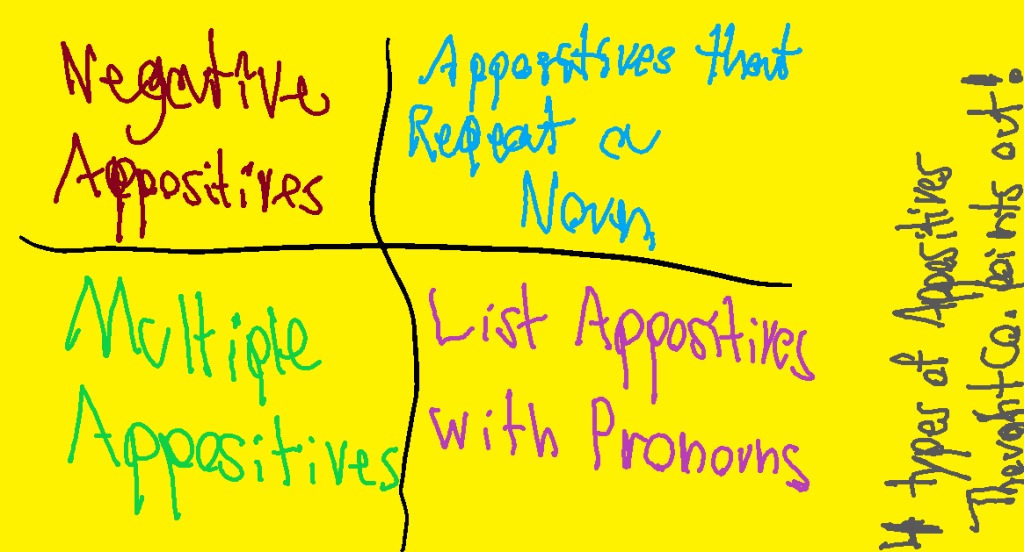
According to ThoughtCo., an education site whose writers have advanced degrees, appositives can do more than simply rename a noun with more context. They can also:

  • “Repeat a noun for the sake of clarity and emphasis” – Appositives that Repeat a Noun
    • Ex: Give Sarah my thanks, my thanks for her hospitality while we searched the hotel room.
  • “Identify what someone or something is not” – Negative Appositives
    • Ex: Teachers, rather than janitors, were expected to clean up a student’s mess in the classroom.
  • Appear beside a noun or pronoun two or more times – Multiple Appositives
    • Ex: Jimmy Strictland, manager at Pizza Hut, father of three girls, donated his extra paycheck to a Christmas charity.
  • Form a list that precedes a pronoun, usually the pronouns “all or these or everyone” – List Appositives with Pronouns
    • Ex: Taking out the trash before 9 PM, doing dishes before bed, quieting the TV while your parents are asleep—these tasks aren’t required when you live on your own.

ThoughtCo. points out more appositive variations as well, like nonrestrictive v. restrictive appositives and appositive adjectives.

There’s more too!

If you’re an English speaker, odds are you’ve used an appositive before, and you’re likely to use one again. In its ubiquity, the technique unites us, but what makes each of us unique is the variations in our usage. As ThoughtCo. proves, we have a lot of options.

What do you think of appositives? Have you heard of the technique before? How will you use the various forms in your own writing?

Slips Away

His wrists were curled onto the banister. They were weightless, a draped towel. The fluff of his palms connected with the cold metal. Despite this, hot sweat still formed on his fingertips. The fingers themselves were motionless, stale like an uneaten pretzel. They couldn’t move even if he wanted them to… He wanted them to. On both wrists his pulse pounded porcupines. He could grab the railing with his bare fingers, but after being motionless so long he feared they’d snap like frozen carrots. Had his wrists not been pressing against the banister, he would have leaned forward too far, falling four floors to his doom.

* * *

A pink sunset. Orange clouds, only a few, dotting an azure sky. From the roof he could still smell honey from the garden. The scent of tall uncut grass tickled his nostrils. He didn’t know it, but he was scowling. His forehead had relaxed into a folded, wrinkled position.

* * *

Nostalgia was his least favorite emotion. That’s why he was so dour in this moment. It felt like it could have been yesterday. There were no words in his memory. Only images and sensations. Two floors below in this very building, a large storage area. A giant flat cube, with smaller flat cubes in it. Each in a different color. An old iPhone on a table hooked up to speakers. A group, about a dozen, and himself, dancing. Fast. Stomping on those cubes, trailing off onto the concrete floor. A girl. Gentle fingers, clay that molded perfectly into his. She led him upstairs.

* * *

He could see her well now. Jet black hair that shot straight down from her head and stopped at the small of her back. Glistening off her hair was the pink light of the sun. She wore jeans and a loose cream-white sweater. Along the sleeves were perforated bunnies. She smiled wide, an invitation to ask her anything. He glanced at her earth brown skin. It radiated a warm aura. He could feel it, even from the short distance that separated them. This moment, he thought, was the perfect opportunity. To say something. Anything. What to ask her? He found himself staring at her eyes longer than he had realized. She looked puzzled. Perhaps he was not aware that he was quivering, so when he attempted to ask her what he wanted to ask her, she simply laughed him off. Or was she laughing with him? She must have expected him to say something, because he was silent for a long time, and he can vividly remember watching her smile melt away. After that, all he could remember was that she left.

* * *

He wished they’d stayed in the dark. There, they were equal. There, he felt self-worth.

Two Blind Men

Hills rose above the trees in Mt. Airy. McCallum St. barreled down from Glen Echo Rd at the hill’s top to Lincoln Drive at the foot of the incline. Despite its grand size, the slope’s drop was not abrupt for passersby advancing up or marching down the hill. Road bumps acted as safety nets, warning attentive drivers there was still some road to go until a turn onto bustling Lincoln Drive.

On either side of the incline were homes two-to-three floors tall. These houses were wide, front lawns lined with daffodils and colorful flowers. The homes were rectangular, slanting on the McCallum St. hill like homes in San Francisco.

A blind, elderly man aimlessly wandered uphill. He wore a tattered navy-blue jacket, a paint splotched puce green t-shirt and faded jeans. A warmth waved on him from the face down. It was a bright, cloudless day. Normally he’d sit at peace on a bench somewhere, but a darkness preoccupied him.

He couldn’t see. His cane had been broken in half the previous night, and the half stick he had left was not making a loud enough sound to see properly. Haphazard taps clacked off the ground as he hunched over, using a tool half his arm length.

Digital clicks echoed in a car as the driver squinted at his phone, trying to finish his text telling his wife how nice the weather today was. He was so focused that he sped over the road bumps on the hill, careened to the bottom, and hit a figure walking, causing a boom of cracked bones and torn flesh as the figure rolled onto the windshield. The driver’s engine sputtered and he veered into a tree.