

We, English speakers, share a habit that thrives regardless of our intelligence level. It’s a habit we tend to be unaware of.
I’ve been thinking about appositives lately, how they buffer a sentence’s pace, the way they succinctly add context to a noun. It wasn’t until I took a grammar course last year that I learned the term and its function, but ever since, I see it everywhere.
Purdue University’s writing resources hub, Purdue OWL, defines appositives as “a noun or pronoun — often with modifiers — set beside another noun or pronoun to explain or identify it.”

The first sentence of this post contains an appositive. Here’s another example:
Barry, a choir singer, trilled a melody for Adrienne’s, his wife’s, birthday.
(The underlined is the appositive, which renames/adds context to the pronoun beside it.)
Notice how cutting “Barry” and “Adrienne” would still leave a functioning sentence. Only, you wouldn’t know the singer or his wife’s name.
You could swap what gets kept and cut, but without the context of “a choir singer,” one might assume “Barry trilled” meant “Barry played an instrument” (instead of “Barry sang”). Cutting “his wife’s” would leave Barry and Adrienne’s relationship ambiguous.
If you pay attention to yourself or others talking, you may find yourself using an appositive without thinking about it. In fact, you’ve likely used them before you knew what they were.

Photo by PNW Production on Pexels.com
How is this possible? It’s because speech is an act of mimicry. We learn how to talk from our parents and then from the people around us. While some things are region-exclusive, like a preference for saying pop instead of soda, other things are universal, like facets of grammar/speech.
You don’t need to know what an idiom is to recognize the phrase “it’s raining cats and dogs.” Likewise, many English speakers use appositives without knowing what an appositive is. Because appositives are a speech pattern, not exclusively a written one, even people who are illiterate use them.
I think it’s humbling that we share speech patterns like appositives, conscious of it or not. We all have a beating heart and a spongey brain. The similarities in how we write and talk are just more evidence that underneath our idiosyncrasies we’re built the same.
But if we’re built from the same parts, what makes us unique? Perhaps our uniqueness emerges from the differences in how we use those parts. As English speakers, we all use appositives, but the frequency each person uses them varies. We also make our each of our uses of appositives unique by choosing specific types.
According to ThoughtCo., an education site whose writers have advanced degrees, appositives can do more than simply rename a noun with more context. They can also:
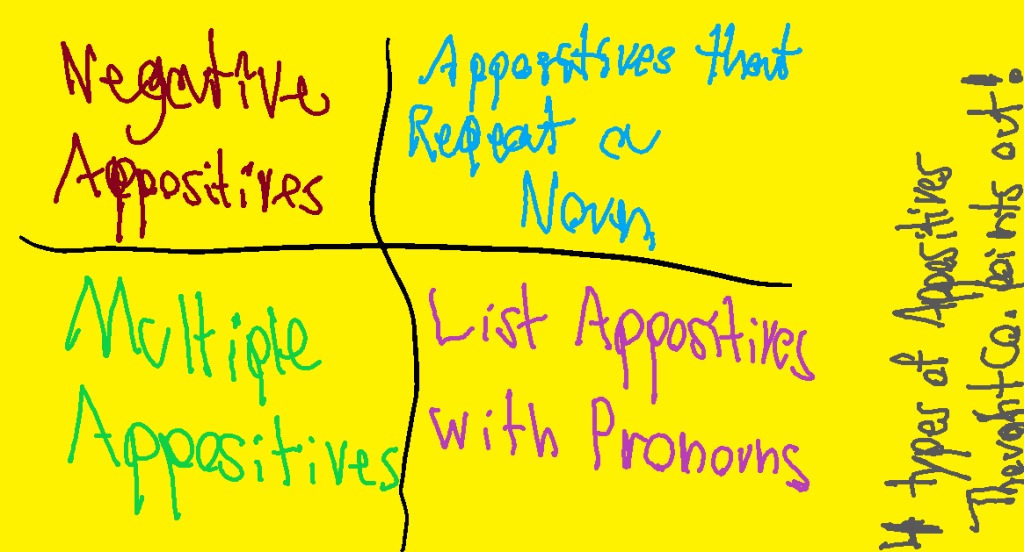
- “Repeat a noun for the sake of clarity and emphasis” – Appositives that Repeat a Noun
- Ex: Give Sarah my thanks, my thanks for her hospitality while we searched the hotel room.
- “Identify what someone or something is not” – Negative Appositives
- Ex: Teachers, rather than janitors, were expected to clean up a student’s mess in the classroom.
- Appear beside a noun or pronoun two or more times – Multiple Appositives
- Ex: Jimmy Strictland, manager at Pizza Hut, father of three girls, donated his extra paycheck to a Christmas charity.
- Form a list that precedes a pronoun, usually the pronouns “all or these or everyone” – List Appositives with Pronouns
- Ex: Taking out the trash before 9 PM, doing dishes before bed, quieting the TV while your parents are asleep—these tasks aren’t required when you live on your own.
ThoughtCo. points out more appositive variations as well, like nonrestrictive v. restrictive appositives and appositive adjectives.
If you’re an English speaker, odds are you’ve used an appositive before, and you’re likely to use one again. In its ubiquity, the technique unites us, but what makes each of us unique is the variations in our usage. As ThoughtCo. proves, we have a lot of options.
What do you think of appositives? Have you heard of the technique before? How will you use the various forms in your own writing?
 The Fiction Writer