Word Choice Exercise #1

Here’s an attempt at an exercise I found in Henneke Duistermaat’s article, Word Choice: How to Play With Words (and Find Your Voice). You can find more exercises and tips on her website, enchantingmarketing.com.

Five Character Variations of: “I’m a … and I’m on a mission to …”

(1.

I’m a carpenter, yes, I just spotted mold by your electrical outlet, hm? I’m on a mission to do my job but with such a mess how can I do my job for you?

(2.

Hiya! I cashier here at Monae’s Boutique, so lovely of you to stop in! Is this for an anniversary or a first date? I can see the butterflies in your eyes—smile!—I’ve got just the flowers to make her day.

(3.

Yeah. I work at Monae’s, you lost? Well sorry, I don’t get paid to give directions, my job’s to sell flowers. The other employers trashed my resume.

(4.

I-I’m… Hi, I’m Caden. My mommy dropped me off for furst day school. I’m fourth grade…

(5.

Portia Clementine, junior reporter for the Onyx Observer, here to stomp the gas so your story will be free and be heard by millions of Americans and so your life will be saved.

Construction Variations #1: To ___ Is To ___

Five Examples of the Preset Pattern’s Variations

(1.

Ah, young pupil. To fail is to improve. No artist gets it right on the first try.

(2.

To feel the frigid winds whilst dangling upside-down by bungee cord’s half-inch thread is to feel every victory and mishap, every warm tear and cold kiss, every memory rush in and out of consciousness within seconds.

(3.

Eh, whaddya gonna do? “To love is to lose” or somethin’, amiright?

(4.

To slip in my pronunciation of that single syllable for two seconds in that thirty-minute speech is basically to pee my pants in a $400 dollar blazer.

(5.

To run outside but get stung by bees anyway is to be 10, free, and alive…! Now I let the bees sting me and don’t protest.

Tom Wolfe: Substance Over Style(?)

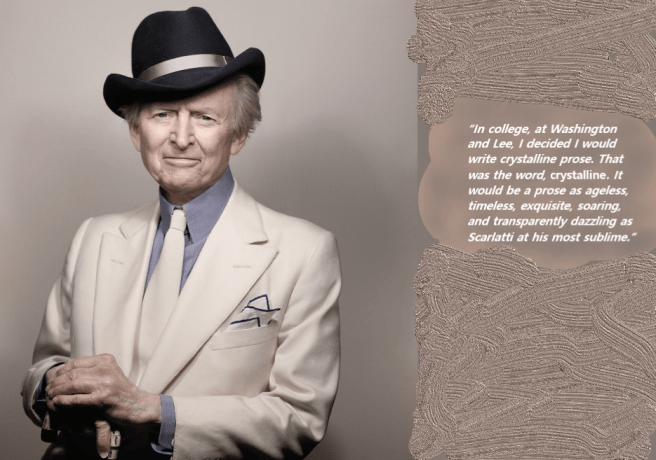
Renowned journalist Tom Wolfe says in his essay, Stalking The Billion-footed Beast, that the perfect story is 65% material and 35% writing skill, but I believe these percentages aren’t hard rules. A strong writing style can encompass 75% of what makes a story successful while material can be cut as low as 25%.

Some Definitions

Tom Wolfe’s quote: “I doubt that there is a writer over forty who does not realize in his heart of hearts that literary genius, in prose, consist of proportions more on the order of 65 percent material and 35 percent the talent in the sacred crucible.”

Wolfe was a journalist who became a novelist; to write his books, he conducted interviews, took notes on landscapes, did research… So, when he says “material” in his essay, he’s referring to the plot, the characters, and the research/inspiration behind the plot and characters. On the flipside, instead of the content of the narrative, writing skill involves the method of how the narrative is written.

When referring to writing skill, Wolfe calls a piece of writing “prose.” Merriam-Webster defines prose as “the ordinary language people use in speaking or writing.” (See the website, Literary Devices, for a more comprehensive definition!) Prose is fiction, essays, text messages, emails—anything that is not poetry. But everybody has their own writing style, and by manipulating it, prose can take infinite shapes and tones, even resembling poetry. This has drastic effects on a narrative: a simple story about waiting for the bus could be made interesting with a narrator that speaks in vivid, one paragraph sentences.

In his essay, Wolfe says he wanted his prose to be “exquisite” and “soaring” for his novel. In other words, he wanted to alter the style of his prose to be exquisite and soaring. ThoughtCo. defines style in writing as “the way in which something is spoken, written, or performed…it is broadly interpreted as representing a manifestation of the person speaking or writing.”

If we each have our own writing style then, like speech, we can change our tone, word choice, and sentence length to affect the message we convey. Think of a casual English speaker who only knows how to talk versus a voice actor who can talk high-pitched, low-pitched, sing, mumble, groan, mimic, make bird calls, etc. We shouldn’t feel constrained in a particular style; with practice, our writing can be as versatile as an actor who plays two vastly different roles.

Putting Style Over Substance Can Make Great Fiction

Here are some examples of fiction that prioritizes style much more than material. In fact, if written in a more plain style, much of the stories’ appeal would diminish.

Weike Wang’s Chemistry

If you asked me what is most memorable about Weike Wang’s novel, Chemistry, I would say it’s the writing style—easily. She uses her style to entertain us outside of plot details.

On the first page of the novel, after the protagonist is proposed to by her boyfriend, there are these lines:

The lab mate says to make a list of pros and cons.

Write it all down, prove it to yourself.

She then nods sympathetically and pats me on the arm.

The lab mate is a solver of hard problems. Her desk is next to mine but is neater and more result-producing.

Notice how the protagonist, speaking in first person, says “the labmate” instead of “my labmate.” And how Wang put “solver of hard problems” instead of “problem solver.” We follow Wang’s protagonist and meet other characters throughout the story. But instead of descriptive settings, we’re engaged by refreshing prose, prose of a style not quite human but not quite robotic. Cheeky robotic maybe.

There are other flyers posted, one that is seeking tutors in math or science.

EXCELLENT PAY, it says, DOUGH, DOUGH, AND MORE DOUGH.

I take this flyer with me. I could use dough.

To buy the things that I want.

Like pizza.

Lydia Davis’ Wife One In Country

Lydia Davis is known for her short fiction, so she makes every word count. She often makes the sum do more than the plot. In her short story, Wife One in Country, she makes a sad story lyrical and comical by her word choice: she doesn’t use any determiners (words like “the,” “this,” “that,” or “a”) and she repeats phrases multiple times close together. Here is an excerpt:

Wife one calls to speak to son. Wife two answers with impatience, gives phone to son of wife one. Son has heard impatience in voice of wife two and tells mother he thought caller was father’s sister: raging aunt, constant caller, troublesome woman. Wife one wonders: is she herself perhaps another raging woman, constant caller? No, raging woman but not constant caller. Though, for wife two, also troublesome woman.

Stories like Davis’ are a fun ride; her prose teaches us new ways English can be used. In stories like this, style is a stronger asset than material.

Donald Barthelme’s Rebecca

A final example is in Donald Barthelme’s short story, Rebecca. Like Davis’ story, in Barthelme’s story it is the narrator’s word choice, rather than a character’s, that is most memorable about the story:

Rebecca Lizard was trying to change her ugly, reptilian, thoroughly unacceptable last name.

Not only does the narrator’s personality stick out, but also how they stack three adjectives in a row. Techniques like this cannot be ignored and are done throughout the story.

Stories With Less Material Are Less Deep?

The three examples I’ve shown use clever wordplay, but the stories they are from don’t have as much material as Tayari Jones’ American Marriage, a love story that looks at race, unjust treatment of prisoners, southern culture, and more. While it does have unique elements like epistolary chapters, the book focuses much more on material than style. So does style-over-substance fiction just mean a fun read with no depth? Is material like plot, character, and setting obligated to be prioritized over a experimental or a refined, uncommon style?

No. Style will always be a significant element of fiction. Look at Raymond Queanu’s Exercises In Style, a book in which the same scene is written in 99 different styles. Look at Mark Z. Danielewski’s House of Leaves, a detective story with some pages of text rotated 180 degrees, other pages painted in an array of colors smeared from corner to corner, forcing the reader to decipher a meaning. These stylistic elements affect the reading experience far more than plot and character could, and they leave readers thinking afterward.

To Conclude: Choose Your Words Wisely

Plot, character, and setting will always be important components of a story, but within that list should be “style.” No matter how good the material, a story might be written poorly if word choice and stylistic elements aren’t used adeptly. Likewise, a shallow story can be made excellent through the use of clever wordplay.

What do you think of style? How important is it to you compared to characters or plot?

My Writing: Before And After Learning Abt. Prose Style

[This Post Was Taken From A 5/31/20 Entry In My Writer’s Journal]

“I’m going to give it to you straight, writing takes effort. You can’t write a passage once a month and expect to become a major selling author. This is something I was forced to open my eyes to and something every writer should know.”

– Jamal H. Goodwin Jr., Create Before You Critique, January 2016

“My insistence on the merits of style is not meant to discount genre. Readers should know what experience they desire and be able to purchase it. But it’s undeniable that style precedes genre. Otherwise, besides plot, all detective stories would read the same!”

– Jamal H. Goodwin Jr., The Macchia of Literature, March 2020

College has done a lot of good for me. My drive to learn combined with Temple’s abundant opportunities created a mental machine, a writing windmill with infinite energy. The wheel’s turning is constant and electric. Touch and you’ll get zapped.

It’s funny how many people told me I didn’t need college to be a writer, how many people raised an eyebrow when I declared I was an English major. They said, “but you could just start your book now. You could self-publish. Write for practice and you’ll learn everything you need.”

There are many writers out there. The writing community on Twitter alone likely comprises of hundreds of thousands of people. Many are successful, and many have a degree outside of English or no degree at all.

Still, many DO have a degree. The entire world of literary fiction is dominated by pompous or reticent, avant-garde MFA holders. And unconventional knowledge of groups like OULIPO or works like Kathy Acker’s Great Expectations? I’d be hard pressed to find any normal person, any non-writer tell me about them.

And these literary works/groups aren’t trending on the internet. Everything is Stephen King or J.K. Rowling. It’d be a miracle if non-college Jamal found out about Weike Wang’s Chemistry or Alexandra Kleeman’s You Too Can Have A Body Like Mine.

I say all of this to say, my approach to writing has changed since going to college. A concrete example is my acquired knowledge on prose. It’s hard to believe I even knew that word in high school, but now that I’ve learned the rules of prose, I’ll never forget it. Poetry is poetry, and not-poetry is prose. And I must say, my prose was weaker when I was younger. I used to use or eschew commas willy-nilly, not knowing they demarcated phrases and parentheticals.

The first quote I used at the beginning of this entry is of an article I wrote for my high school newspaper. My first sentence in that quote uses a comma incorrectly; it separates two clauses, making it a comma splice, which is a type of fused sentence. The second quote is from a more recent work, and I use commas in it correctly. The line “besides plot” is in-between two commas; it’s a parenthetical. High school me had no knowledge of sentence types or basic grammar rules.

Interestingly, young-me did have some good sentences up his sleeve. What’s below comes from my fanfic of Tananarive Due’s African Immortals series:

“Dawit’s wife, Jessica, was once a mortal herself, until Dawit feared he’d lose her forever and forced the ceremony upon her.”

– Jamal H. Goodwin Jr., Teka’s Travels, December 2014

In the excerpt, before I knew what the technique was, I used an appositive (“Jessica” stands in for “Dawit’s wife”) and a subordinate conjunction and clause (“until Dawit feared…”). I suppose some grammar techniques are picked up after frequent reading/writing.

My knowledge attained thus far excites me. Knowing the names of the skills I’ve used allows me to use and not use them at will.

Writing Through Space And Time

Two days ago, I was talking to my mom about reading, and with a wistful sigh, she said, “it’s such an escape.” I wanted to ask to where, but I should have asked, “how did you get there?” Actually, reader, where were my mom and I? What did you see?

I ask because words can do two things: convey information or describe a scene. Sometimes both happen simultaneously, but these words I’m saying? They’re only sounds in your mind. You can’t see me in my room typing in my red chair until I’ve told you. This technique is very useful.

Pretend you’re reading a novel. The protagonist hugs their crush in school, and for two paragraphs, time freezes while the narrator voices the protagonist’s thoughts. A novel that only showed setting and action couldn’t voice character thoughts. Conversely, a novel frozen in time to explain character thoughts would lack visuals.

Words can convey information, describe time and place, or do both.
Photo by Miguel Á. Padriñán on Pexels.com

Here’s a sample of what I mean. Note the italics versus bold. (1): To Andre, the worst kind of movies were old westerns. They were all the same: reckless hero with a sharp jawline, damsel in distress who has no opinions of her own, and endless montages of horseback riding.

(2): To Andre’s horror, a cowboy movie was playing when he returned to the physics classroom. He stood motionless by the door, his friends folding their arms or hunched forward. This is what they chose to watch?! He turned to leave but someone waved and pointed to an open seat.

In example (1), the narration is info-conveying. There are hints of visuals like the hero’s jawline, which you may have envisioned, but I’ve withheld knowledge of Andre’s location and actions—he is frozen in time. Example (2) animates Andre and the scene with phrases like “physics classroom” and “stood motionless.”

We are all skilled at info-conveying and descriptive writing. We’ve encountered the forms in essays and fiction. And yet, like other literary techniques, when we write, we tend to use the two forms unconsciously. Be aware of which form you’re using, and experiment with the ratio that you use them!