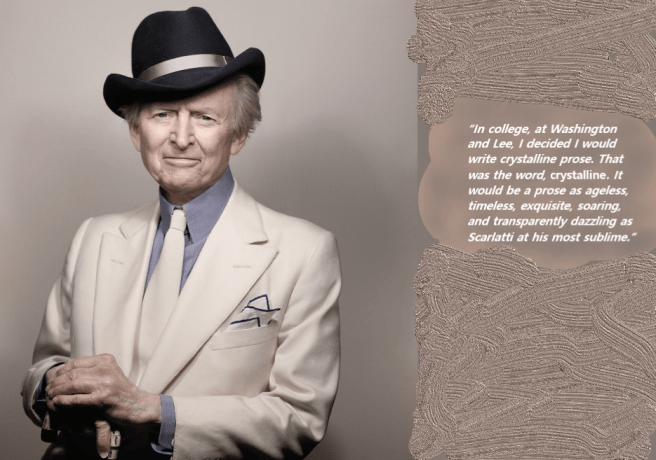
Renowned journalist Tom Wolfe says in his essay, Stalking The Billion-footed Beast, that the perfect story is 65% material and 35% writing skill, but I believe these percentages aren’t hard rules. A strong writing style can encompass 75% of what makes a story successful while material can be cut as low as 25%.
Some Definitions
Tom Wolfe’s quote: “I doubt that there is a writer over forty who does not realize in his heart of hearts that literary genius, in prose, consist of proportions more on the order of 65 percent material and 35 percent the talent in the sacred crucible.”
Wolfe was a journalist who became a novelist; to write his books, he conducted interviews, took notes on landscapes, did research… So, when he says “material” in his essay, he’s referring to the plot, the characters, and the research/inspiration behind the plot and characters. On the flipside, instead of the content of the narrative, writing skill involves the method of how the narrative is written.
When referring to writing skill, Wolfe calls a piece of writing “prose.” Merriam-Webster defines prose as “the ordinary language people use in speaking or writing.” (See the website, Literary Devices, for a more comprehensive definition!) Prose is fiction, essays, text messages, emails—anything that is not poetry. But everybody has their own writing style, and by manipulating it, prose can take infinite shapes and tones, even resembling poetry. This has drastic effects on a narrative: a simple story about waiting for the bus could be made interesting with a narrator that speaks in vivid, one paragraph sentences.
In his essay, Wolfe says he wanted his prose to be “exquisite” and “soaring” for his novel. In other words, he wanted to alter the style of his prose to be exquisite and soaring. ThoughtCo. defines style in writing as “the way in which something is spoken, written, or performed…it is broadly interpreted as representing a manifestation of the person speaking or writing.”
If we each have our own writing style then, like speech, we can change our tone, word choice, and sentence length to affect the message we convey. Think of a casual English speaker who only knows how to talk versus a voice actor who can talk high-pitched, low-pitched, sing, mumble, groan, mimic, make bird calls, etc. We shouldn’t feel constrained in a particular style; with practice, our writing can be as versatile as an actor who plays two vastly different roles.
Putting Style Over Substance Can Make Great Fiction
Here are some examples of fiction that prioritizes style much more than material. In fact, if written in a more plain style, much of the stories’ appeal would diminish.
Weike Wang’s Chemistry
If you asked me what is most memorable about Weike Wang’s novel, Chemistry, I would say it’s the writing style—easily. She uses her style to entertain us outside of plot details.
On the first page of the novel, after the protagonist is proposed to by her boyfriend, there are these lines:
The lab mate says to make a list of pros and cons.
Write it all down, prove it to yourself.
She then nods sympathetically and pats me on the arm.
The lab mate is a solver of hard problems. Her desk is next to mine but is neater and more result-producing.
Notice how the protagonist, speaking in first person, says “the labmate” instead of “my labmate.” And how Wang put “solver of hard problems” instead of “problem solver.” We follow Wang’s protagonist and meet other characters throughout the story. But instead of descriptive settings, we’re engaged by refreshing prose, prose of a style not quite human but not quite robotic. Cheeky robotic maybe.
There are other flyers posted, one that is seeking tutors in math or science.
EXCELLENT PAY, it says, DOUGH, DOUGH, AND MORE DOUGH.
I take this flyer with me. I could use dough.
To buy the things that I want.
Like pizza.
Lydia Davis’ Wife One In Country
Lydia Davis is known for her short fiction, so she makes every word count. She often makes the sum do more than the plot. In her short story, Wife One in Country, she makes a sad story lyrical and comical by her word choice: she doesn’t use any determiners (words like “the,” “this,” “that,” or “a”) and she repeats phrases multiple times close together. Here is an excerpt:
Wife one calls to speak to son. Wife two answers with impatience, gives phone to son of wife one. Son has heard impatience in voice of wife two and tells mother he thought caller was father’s sister: raging aunt, constant caller, troublesome woman. Wife one wonders: is she herself perhaps another raging woman, constant caller? No, raging woman but not constant caller. Though, for wife two, also troublesome woman.
Stories like Davis’ are a fun ride; her prose teaches us new ways English can be used. In stories like this, style is a stronger asset than material.
Donald Barthelme’s Rebecca
A final example is in Donald Barthelme’s short story, Rebecca. Like Davis’ story, in Barthelme’s story it is the narrator’s word choice, rather than a character’s, that is most memorable about the story:
Rebecca Lizard was trying to change her ugly, reptilian, thoroughly unacceptable last name.
Not only does the narrator’s personality stick out, but also how they stack three adjectives in a row. Techniques like this cannot be ignored and are done throughout the story.
Stories With Less Material Are Less Deep?
The three examples I’ve shown use clever wordplay, but the stories they are from don’t have as much material as Tayari Jones’ American Marriage, a love story that looks at race, unjust treatment of prisoners, southern culture, and more. While it does have unique elements like epistolary chapters, the book focuses much more on material than style. So does style-over-substance fiction just mean a fun read with no depth? Is material like plot, character, and setting obligated to be prioritized over a experimental or a refined, uncommon style?
No. Style will always be a significant element of fiction. Look at Raymond Queanu’s Exercises In Style, a book in which the same scene is written in 99 different styles. Look at Mark Z. Danielewski’s House of Leaves, a detective story with some pages of text rotated 180 degrees, other pages painted in an array of colors smeared from corner to corner, forcing the reader to decipher a meaning. These stylistic elements affect the reading experience far more than plot and character could, and they leave readers thinking afterward.
To Conclude: Choose Your Words Wisely
Plot, character, and setting will always be important components of a story, but within that list should be “style.” No matter how good the material, a story might be written poorly if word choice and stylistic elements aren’t used adeptly. Likewise, a shallow story can be made excellent through the use of clever wordplay.
What do you think of style? How important is it to you compared to characters or plot?



 The Fiction Writer